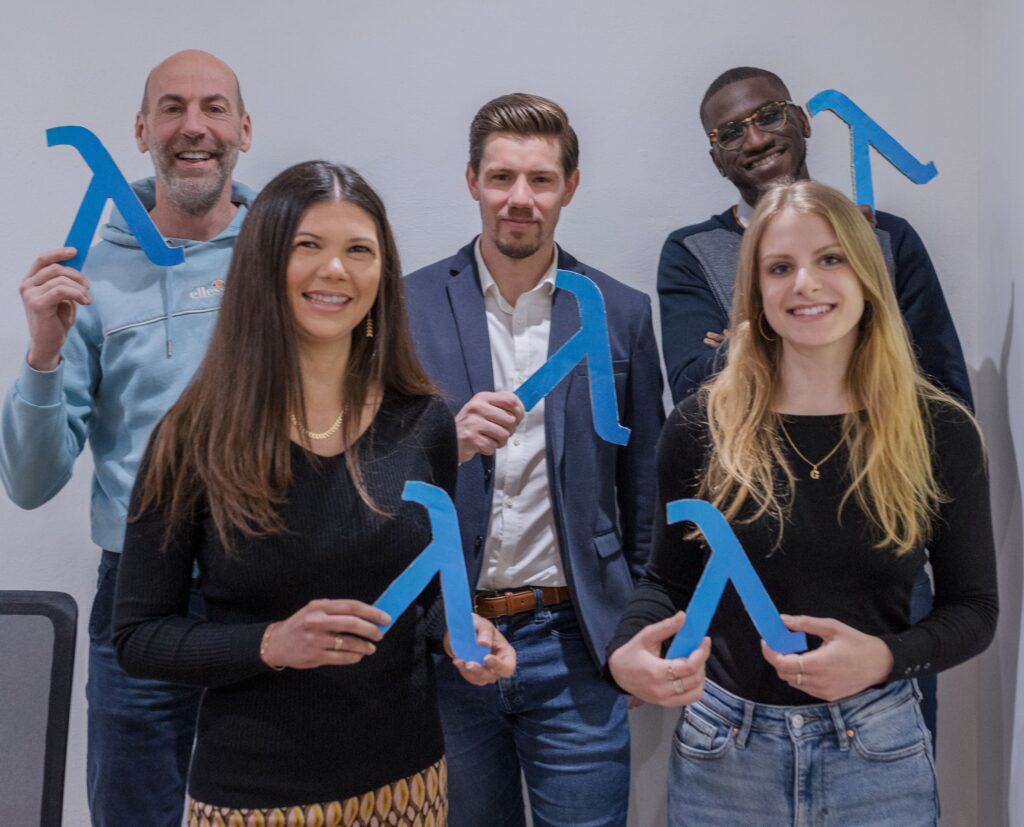
What is the secret to the rapid success of the fluorescent nanoparticles developed by the Strasbourg-based startup Poly-Dtech? Of course, it’s the hard work that led to a brilliant scientific achievement, but it’s also the complementary expertise of two researchers from the University of Strasbourg and the CNRS, driven by a shared entrepreneurial spirit to contribute to the advancement of science in the service of research and health.
Poly-Dtech is the story of a collaboration between Loïc Charbonnière, director of the Synthesis for Analysis (SynPa) team at the IPHC*, and his Ph.D. student Joan Goetz. Together, they revived Loïc Charbonnière’s research on enhancing the brightness of lanthanide nanoparticles—metal ions used for biomarker detection in microscopy. First in the lab and then at the University of Hong Kong in 2017, Joan Goetz spent months testing different lanthanides. His goal: to develop “ultra-fluorescent” nanoparticle technology. A biological targeting and labeling capability will then be added with a view toward applications in in vitro research and diagnostics.
Today, the co-founders of Poly-Dtech aim to ensure the company’s long-term viability and growth. Indeed, its portfolio of products and services is expanding, its team is gaining expertise in chemistry, biology, and marketing, and its customer base is growing in France and across Europe. Although the company has been self-funded since its inception, Poly-Dtech is now considering a fundraising round, specifically to develop a multiplexed time-resolved fluorescence (TR-FRET) technique—one capable of analyzing multiple biomarkers simultaneously. The secrets to this success story? “Complementary expertise and mutual trust,” the two researchers say in unison. “Together, we shared a belief in our technology, an entrepreneurial spirit, and a desire to apply chemistry to improving health . From that point on, we built our project with passion and assembled the Poly-Dtech team around our shared ambitions. Every step of our journey has been a wonderful adventure, and we are proud to see that our company has grown just as we had envisioned.”
Poly-Dtech is now targeting the North American market… while remaining loyal to Strasbourg:“A scientific stronghold at the heart of a biotechnology hub that’s unique in Europe,” explains Joan Goetz, a native of the city.“Not only was the pioneering work on lanthanide luminescent complexes carried out by Strasbourg’s own Nobel laureate Jean-Marie Lehn, but the creation of our startup owes a great deal to the support of the Grand Est Region,” notes Loïc Charbonnière.
* Hubert Curien Multidisciplinary Institute, a joint research unit of the CNRS and the University of Strasbourg (UMR7178) https://iphc.cnrs.fr/