Launch of the New Interdisciplinary Thematic Institutes: A Unique Initiative in the French Academic Landscape
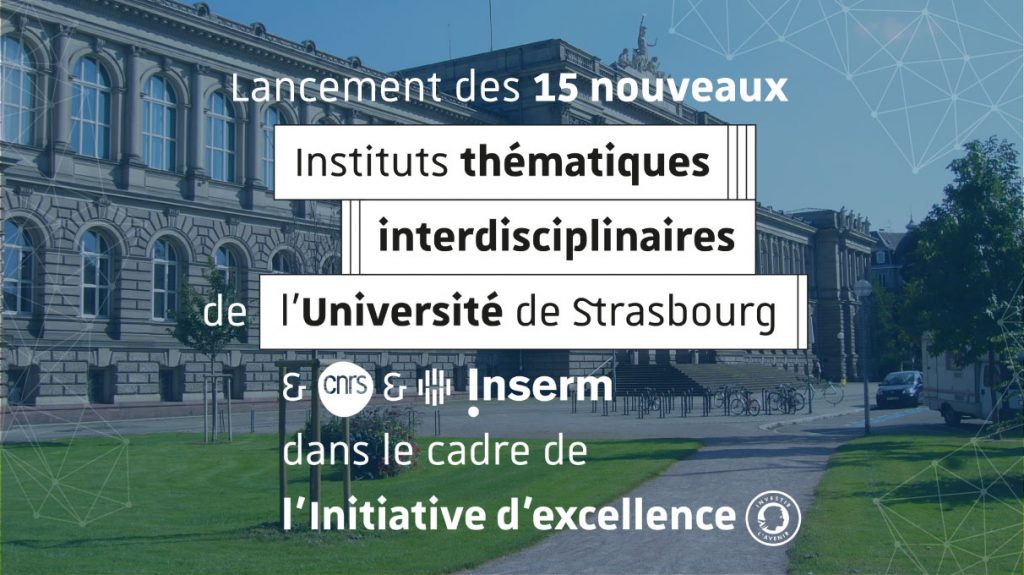
Launched in January 2021, the 15 new Interdisciplinary Thematic Institutes (ITI) are based on a unique structure linking “research and education” by bringing together a cluster of academic laboratories with a research school (a graduate school in the Anglo-Saxon tradition that trains students from the master’s level through the completion of their doctorate). These new institutes are jointly supported by the University of Strasbourg, the CNRS, and Inserm. Among them, four institutes focus on chemistry at the intersections of biology, physics, and materials science:the ITI Chemistry of Complex Systems, the Strasbourg Institute of Medicines,the ITI Hierarchical and Functional Materials for Health, the Environment, and Energy, and the ITI Quantum Sciences and Nanomaterials.
The ITI in Complex Systems Chemistry (CSC)
The Chemistry of Complex Systems is a field of research internationally recognized as an emerging area for 21st-century chemistry. Historically, Jean-Marie Lehn, professor emeritus at the University of Strasbourg and Nobel Laureate in Chemistry, was one of its pioneers. This new institute brings together 250 researchers who apply concepts from molecular and supramolecular chemistry, utilizing the self-organizing and self-assembling properties of matter to develop chemical architectures capable of detecting, manipulating, or transmitting targeted information. This multidisciplinary field has applications in healthcare, materials science, the environment, and information and communication technologies.
In addition to its cutting-edge research activities, the Institute is home to the highly selective CSC University Research School, a graduate school modeled after the Anglo-Saxon system that recruits outstanding international students based on their exemplary academic records. These future researchers follow a multidisciplinary program in chemistry taught in English during their two-year master’s program and are immersed in research laboratories for 14 months of experimentation. Students also receive training in corporate culture (industry-focused courses, management and leadership programs, and internships). This Master’s program is integrated into the Ph.D. program, for which the school provides three years of funding for doctoral students—an initiative supported by the Foundation for Research in Chemistry, which has made fundraising for the school one of its priority projects, having already raised €1.2 million in donations toward a goal of €4.2 million.
Through a donation of 130k€ over three years (or 52k€ after tax deductions), corporate sponsors support a student for the entire duration of his or her thesis. Thanks to the generosity of donors, this institute and its school attract a diverse pool of students trained in innovation management—young chemists who will contribute to the development of new long-term research areas aligned with the societal challenges faced by companies. The ITI CSC school promises to be a breeding ground for the promising academic researchers of tomorrow and the future scientific leaders of the chemical industry.
Learn more: https://fondation-lehn.fr///iti-csc/
The Strasbourg Institute of Medicines (IMS)
The IMS addresses the challenges facing the pharmaceutical industry: conducting cutting-edge research through the preclinical stage, promoting technological innovation through the creation of startups, and training the next generation of researchers in pharmaceutical innovation management.
The institute is built on an integrated structure comprising three divisions that work in close synergy: Medalis, its drug research division; Euridis, its school of drug innovation management; and Inedis, its startup incubation division. Through its unique model and the complementary nature of its three units, the IMS is firmly established at the foundation of the pharmaceutical value chain. The Foundation supports each of these three units by offering companies the opportunity to support:
- The Medalis Research Center, through the creation of a fund in their name, aims to drive new technological advances and ensure the long-term presence of a team of skilled researchers on campus.
- The Inedis incubator, through the creation of a fund dedicated to the development of the most promising pharmaceutical startups.
- Euridis School supports young researchers through the DDD (Drug Discovery and Development) Challenge, an entrepreneurial research project that culminates in the creation of a startup.
From the very start of the Institute, the Roederer insurance brokerage group has supported the DDD Challenge. The company issued a call for proposals in January 2021 aimed at charitable organizations and medical research. Medalis’s reputation and its unique model for supporting projects all the way to the startup stage won over the group. For Geoffroy Roederer (President of the Roederer Group), this donation contributes to goals that are as noble as they are strategic: relocating drug production to our region and encouraging the emergence of new therapies in the heart of Europe.
For more information: https://ims.unistra.fr/entreprises/
The ITI on Hierarchical and Functional Materials for Health, the Environment, and Energy (HiFunMat)
Drawing on fundamental knowledge of chemistry, physics, and biology, HiFunMat develops and characterizes new composite materials to achieve remarkable properties and applications.
The design of these materials is based on the control, at multiple scales, of the composition and three-dimensional spatial arrangement of their components. (Multi)functional building blocks, such as (macro)molecules, (nano)particles, and others, will be assembled using innovative approaches (3D printing, microfluidics, foaming, or multi-step assembly, etc.).
Drawing inspiration from living systems that process information and adapt in response to stimuli, HiFunMat will focus on “active materials” with similar properties.
Like other ITIs, this institute is not limited to its researchers but offers interdisciplinary training through research, from the master’s to the doctoral level. The goal is to meet strong demand from industry for professionals with a solid background in materials science by offering tailored, interdisciplinary training that addresses all aspects of innovation and commercialization—which is essential for tackling future societal challenges (energy, environment, health).
For more information: https://iti-hifunmat.unistra.fr/
The ITI Quantum Sciences and Nanomaterials (QMat)
The QMat Institute addresses an emerging, global demand for cutting-edge research and education in the fields of quantum science and nanotechnology.
Each of its members shares the same scientific vision: to facilitate the critical transition from fundamental quantum science to innovation, with a focus on applications in today’s world. QMat’s approach is based on three pillars:
- Exploring quantum coherence phenomena—leading to a better fundamental understanding of the properties of matter at small scales,
- Exploiting the symmetries arising from systems with reduced dimensions,
- Combining the properties of nanosystems—from properties to functions—with the goal of developing new smart materials and devices.
This institute also offers master’s and doctoral programs for students specializing in quantum sciences and nanomaterials. These future researchers will benefit from the school’s industrial partnerships through internships and “soft skills” courses designed to prepare them for careers in the field of technological innovation. It is an ambitious and highly diverse program aimed at bridging the gap between academic and industrial careers.
For more information: https://www.unistra.fr/index.php?id=32884
Our articles on the same topic