Today, companies face major challenges, both in terms of sustainable development and in the field of health. Reducing greenhouse gas emissions, for example, requires tackling unprecedented scientific challenges. It is no longer simply a matter of limiting CO2 emissions, but of transforming this gas into a useful resource by using it as a carbon source to create new products. Similarly, designing materials that are biodegradable or recyclable at the end of their life cycle represents another major scientific challenge for companies, requiring constant innovation and cutting-edge research.
In the field of health, the challenges are just as complex. Understanding the molecular mechanisms of diseases paves the way for the design and development of new therapeutic molecules. These new scientific challenges can only be met through innovative basic research, grounded in new scientific concepts that can be developed and applied by companies in their markets.
The strength of the University of Strasbourg lies in the quality of its basic research, and it ranks 16th worldwide for its impact on innovation. Producing high-quality science is essential for driving innovation. At the intersection of chemistry and biology, physics, and medicine, the “Chemistry and Frontiers” research cluster at the University of Strasbourg/CNRS is recognized for its excellence. How can we create a clearer, more fluid, and more effective link between its scientific expertise and the technological innovation needs of industry?
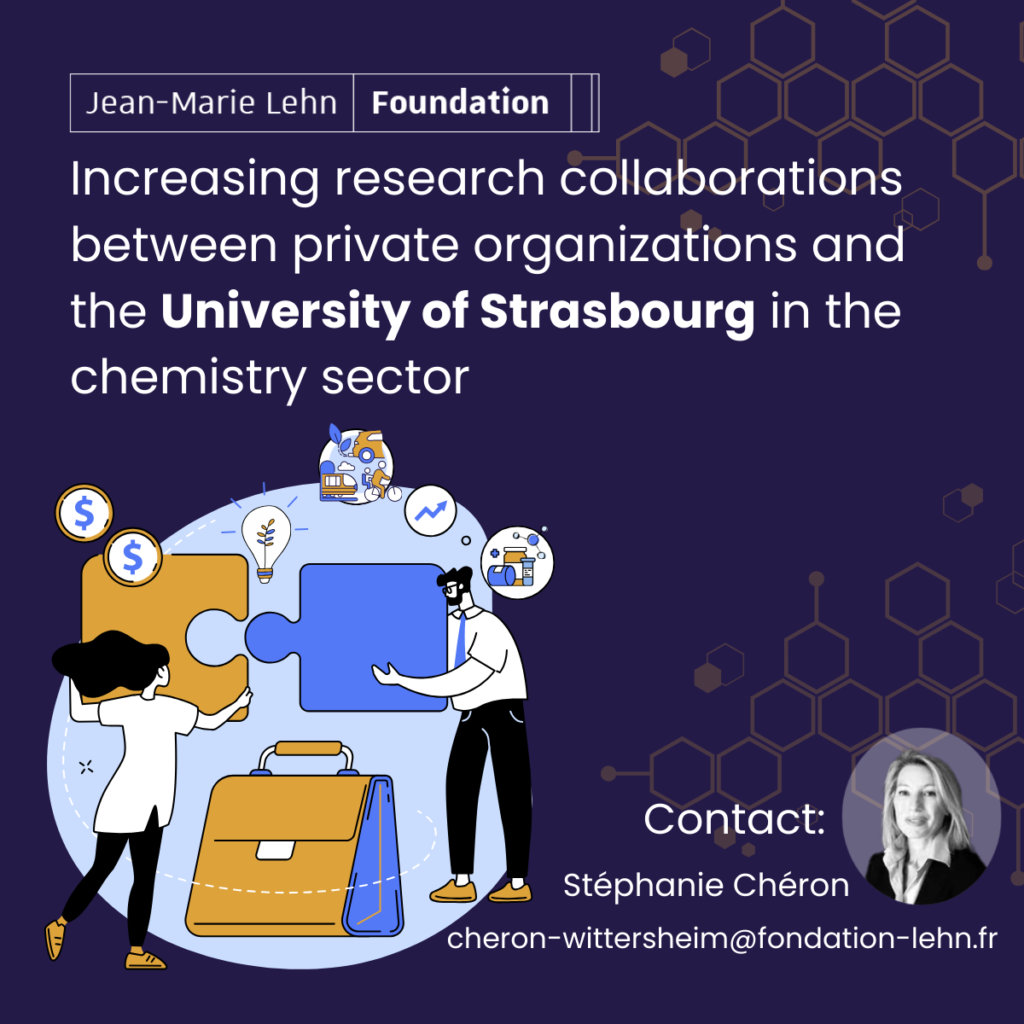
The team in charge of corporate relations at the Jean-Marie Lehn Foundation offers a solution through a new framework for managing and facilitating collaborations. This involves understanding the company’s needs, selecting the appropriate scientific expertise, coordinating exchanges, co-developing scientific concepts, and guiding scientific research toward its technological applications. Clearly structured, this new program combines responsiveness, relevance, and proximity to offer a “tailor-made” solution to companies’ challenges.
The Jean-Marie Lehn Foundation’s new program goes far beyond a mere “skills catalog.” The team quickly provides a tailored response to the company based on its full range of needs. In a concise and accessible format, it presents the scientific expertise most closely aligned with the company’s challenges and the competitive strengths of the selected laboratory or laboratories. The team also takes the initiative in proposing technological innovations. The partnership is then built on shared ideas and discussions that can lead to a collaborative research program. “This approach allows us to work with academic laboratories in a flexible and cross-functional manner, in line with corporate innovation management,” says Stéphanie Chéron.
But that’s not all: the Foundation is committed to providing guidance and support throughout the entire process, thereby ensuring that the project is managed in a way that keeps the expectations and contributions of both parties aligned. In this program, the team therefore acts as a facilitator in the co-development of projects, maintaining at all times the connection between the stakeholders, academic scientific concepts, and the companies’ needs for exploratory research and development.
For the company, this new program is attractive in more ways than one. From the very first point of contact, it offers companies a chance to have their needs heard, a comprehensive overview of available scientific resources, a one-stop shop for guidance toward the right expertise, and relationship management… The Foundation positions itself as a key link in the innovation chain by subsequently connecting companies to the university campus’s commercialization services for technology programs once results are produced.
“Today, companies have a real need for academic expertise to drive new directions in their R&D areas. The Chemistry and Interfaces cluster (which includes biology, materials science, quantum science, artificial intelligence, and more) can address challenges in health and sustainable development by offering disruptive innovations. “With our program, researchers and companies can more effectively collaborate to develop innovative, productive, relevant, and socially beneficial programs,” concludes Stéphanie Chéron.