Drawing inspiration from Réunion's traditional indigenous medicine to develop dermopharmaceutical innovations
For the sixth consecutive year, a highly selective competition organized by the Strasbourg Institute of Medicines has recognized a pair of young researchers working on an innovative project aimed at developing new treatments or diagnostic tools.
As a sponsor of the competition since 2024, AXA Mutuelles will provide funding for three years to support the project of the winners, Yuliia Popa and Hugo Debelvalet. The two scientists are bringing to life a project that has been in the works for more than two years: combining knowledge from traditional medicine with cutting-edge analytical technologies to identify skin treatments.
The DDD Challenge: Encouraging Master's Students to Innovate
The Strasbourg Institute of Medicines (IMS), a research center dedicated to therapeutic innovation, organizes an annual training program called Euridis. This program trains young scientists to design interdisciplinary research projects aimed at addressing a therapeutic need (developing new treatments or improving disease diagnosis). During their second year of the Master’s program, participants develop a research proposal, which they then present to an international panel during the DDD Challenge in order to secure the funding needed to carry it out.
Once again this year, the institute was able to count on the support of AXA Mutuelles to fund two three-year doctoral dissertations in which two young scientists are combining their expertise in an innovative joint project. In June 2025, Yuliia Popa and Hugo Debelvalet won the AXA Prize at the DDD Challenge with an original project designed to explore the therapeutic potential of molecules derived from plants traditionally used on Réunion Island to treat skin conditions, particularly eczema.
Yuliia Popa and Hugo Debelvalet met while pursuing their bachelor’s degrees in chemistry and biology, and they conceived this project even before beginning their master’s program. Initially planning to study medicine, they ultimately turned to pharmaceutical research with the goal of harnessing the therapeutic potential of traditional remedies. Hugo Debelvalet, a native of Réunion, had already heard about certain medicinal plants worth exploring: “Réunion’s flora is extremely diverse, and there are many plants known for their medicinal properties.” In a project we completed toward the end of our bachelor’s degree, we were already able to recognize the potential of these remedies—which are still used today by local communities—and envisioned developing a research project to go further and understand the mechanisms of action of these plants.”
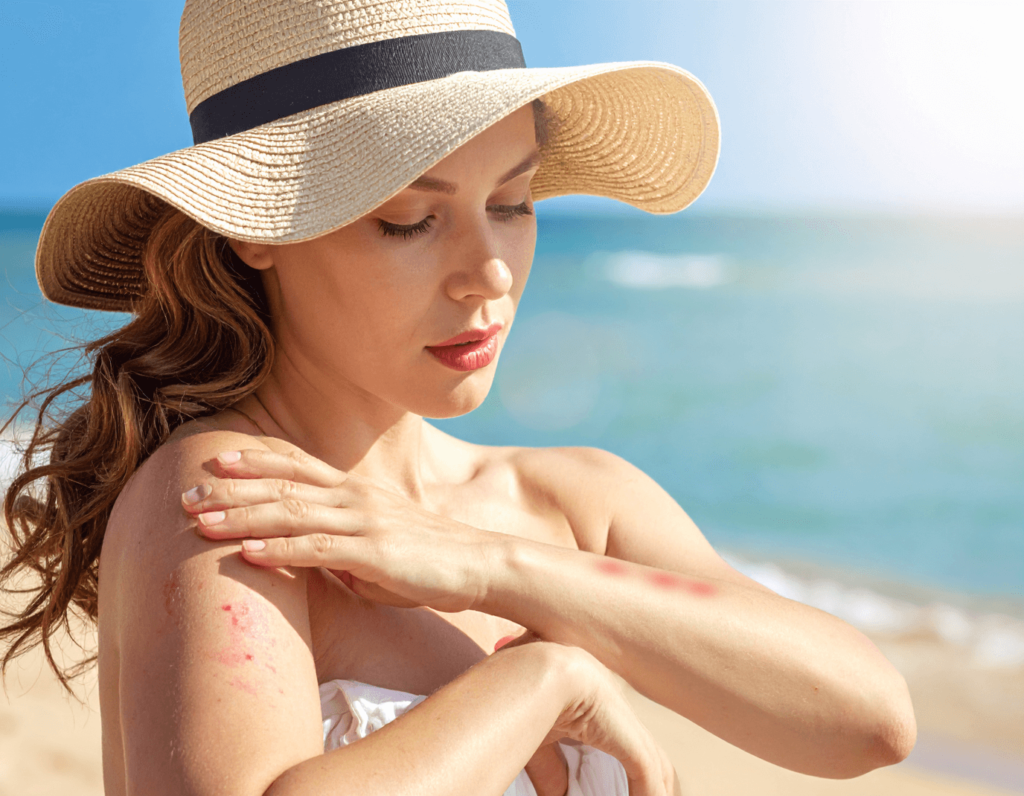
“For my part, I was particularly interested in cosmetics and dermatology,” explains Yuliia Popa, a Ukrainian student who came to Strasbourg to pursue a university degree . “I had a friend who suffered from severe eczema, a skin condition that made daily life very difficult. So we began looking into this traditional pharmacopoeia and the remedies specifically designed to relieve skin conditions.”
During their master’s program, the two students also enrolled in the University Diploma program offered by the Institute of Medicines. The program included courses, lectures, workshops, and coaching to encourage students to envision an entrepreneurial path focused on the development of a drug or diagnostic tools. Yuliia Popa explains that they both chose their Master’s specializations and lab internships with the goal of bringing their project to life: “The IMS supported us with the aspects of the project less directly related to pure science: we conducted market research, learned about intellectual property, and explored future legal structures that could support our innovation, among other things. It’s a comprehensive program that prepares scientists to bring their future innovations to market while addressing all these highly technical aspects.”
Ethnopharmacology for Treating Eczema
Inspired by the empirical uses of plants in various human societies, so-called “ethnopharmacological” studies have provided humanity with more than 60% of itseveryday medications.¹ This approach is therefore highly relevant for discovering new therapeutic molecules, specifically to combat eczema. Yuliia Popa notes that this widespread condition is in desperate need of new solutions: “Eczema is a chronic inflammatory skin disease caused by an abnormal immune response and a compromised skin barrier. More than 3.5 million people inFrance suffer from it,² and the two existing types of therapy have their drawbacks. Corticosteroid-based treatments are inexpensive but cause side effects. Injections of monoclonal antibodies block the action of molecules responsible for this excessive inflammation, but this treatment does not work for all patients and is very expensive. We hope to identify a solution that combines effectiveness, reduced side effects, and affordable costs.”
To identify candidate plants, the first step was to compile an inventory of traditional remedies by creating a bibliography of surveys conducted among traditional practitioners and on folk practices in Réunion. Next, the young researchers plan to move from fieldwork to the laboratory to confirm or refute the therapeutic claims. The goal is to demonstrate a physiological effect by testing a plant extract on cell cultures. Hugo Debelvalet details the stages of their project and each person’s role: “Yuliia will conduct proteomic analyses of human skin cells (that is, analyzing all the proteins contained in these cells) to detect potential interactions between molecules derived from the plant and skin cells. As for me, I’ll be in charge of identifying and extracting the molecules suspected of having a therapeutic effect.”
The young chemist is currently developing a technique to quickly determine whether cells interact with the plant compounds being tested: “I’m using the thermal proteomic profiling (TPP) method. Proteins degrade when the temperature is raised, unless they bind to other molecules, in which case they become more stable and heat-resistant. I’m going to compare treated and untreated skin cells. By observing which proteins in the skin cells remain stable in the presence of a molecule derived from a medicinal plant, I’ll be able to identify its potential targets and better understand its action within the skin cell. ”
The researcher will also test whether applying plant compounds can alter the activity and presence of certain proteins involved in eczema: “We know, for example, that patients produce lower levels of a protein called filaggrin, leading to a dysfunctional skin barrier. It will be interesting to see whether plant extracts applied to skin cells increase filaggrin production. The idea is to analyze even the slightest significant change between treated and untreated cells to understand the mechanisms of action… if there are any!”
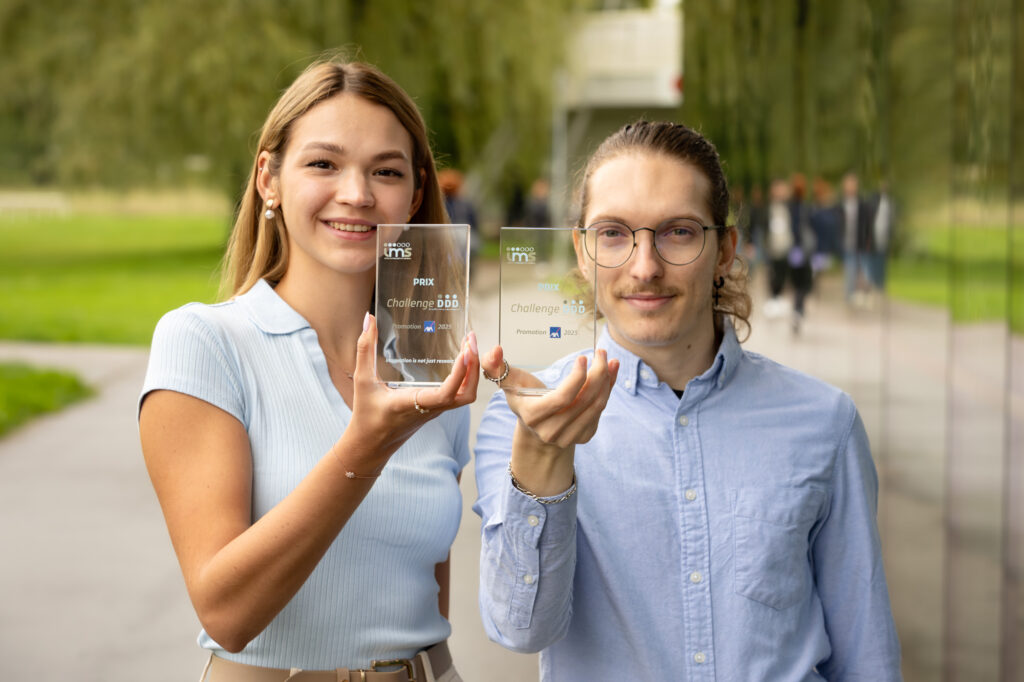
The winning duo of the 2025 DDD Challenge, sponsored by AXA mutual insurance companies.
During the competition, Yuliia Popa and Hugo Debelvalet explained the principle behind their method for testing molecules extracted from medicinal plants on human skin cell cultures. Yuliia Popa is pursuing her Ph.D. in the Bioorganic Mass Spectrometry Laboratory under the supervision of Christine Carapito at the Hubert Curien Multidisciplinary Institute. Hugo Debelvalet is pursuing his Ph.D. in the Therapeutic Innovation Laboratory under the supervision of Sergio Orti.
The DDD Challenge selects projects likely to lead to the creation of a startup in order to make the developed therapeutic innovations available to patients. To that end, the duo hopes that by the time they complete their doctorates (by 2028), the therapeutic molecules they have identified and characterized will be ready to move on to the next stage—preclinical testing—and to commercialize their innovations. The young scientists embarked on this long-planned venture in October 2025 with the goal of discovering new, safe, and effective therapeutic solutions for patients, as well as developing laboratory techniques useful for ethnopharmacological research related to skin diseases.
1. https://www.ethnopharmacologia.org/definition/
2. https://www.dermatite-atopique.fr/comprendre/definition/
Photo credit: Nicolas Busser.
Our articles on the same topic