When the Next Generation of Scientists Meets the Nobel Laureates: A Young Researcher’s Experience at the Lindau Nobel Laureate Meetings

Published on September 26, 2025

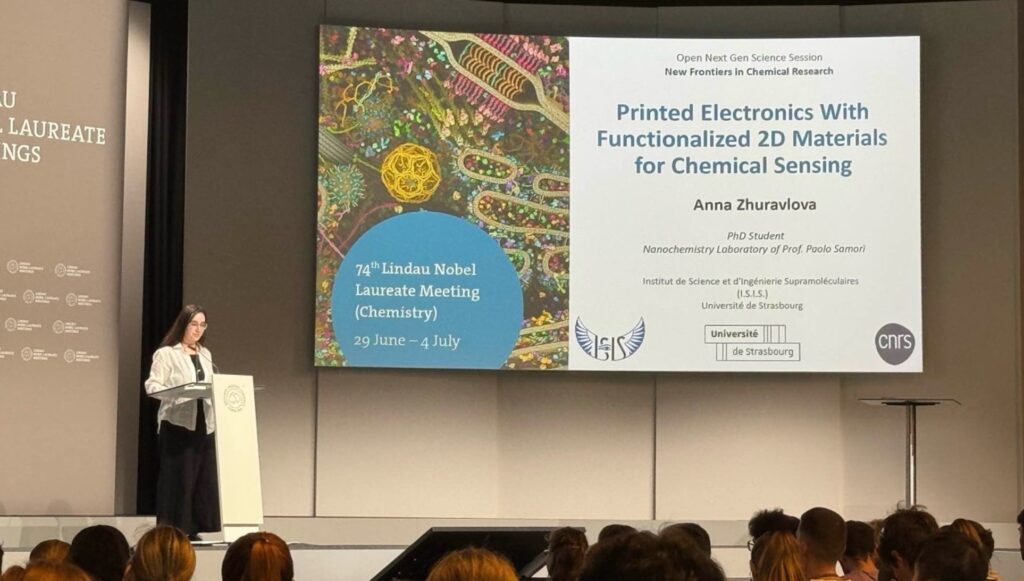
For the past 74 years in Germany, the Lindau Nobel Laureate Meetings have aimed each year to foster exchanges between the next generation of talented scientists and dozens of recipients of the prestigious Nobel Prize. Anna Zhuravlova, a recent Ph.D. graduate in chemistry from the University of Strasbourg and a researcher at the Institute of Supramolecular Science and Engineering (ISIS, Strasbourg), had the honor of being selected to participate in these exceptional meetings this summer. Here’s a closer look at her research and a recap of her extraordinary experience.

A thesis that has garnered attention for its work on developing innovative materials for electronics and tools for water quality control

Anna Zhuravlova is a young Ukrainian researcher who came to Strasbourg in 2020 to complete her final year of a master’s degree in “Chemistry and Physics of Materials” in Strasbourg. In 2021, she continued her studies and began a Ph.D. in the field of nanomaterials. At the intersection of physics and chemistry, she has focused on the development of chemically adaptive/reactive materials and high-performance electronic devices.

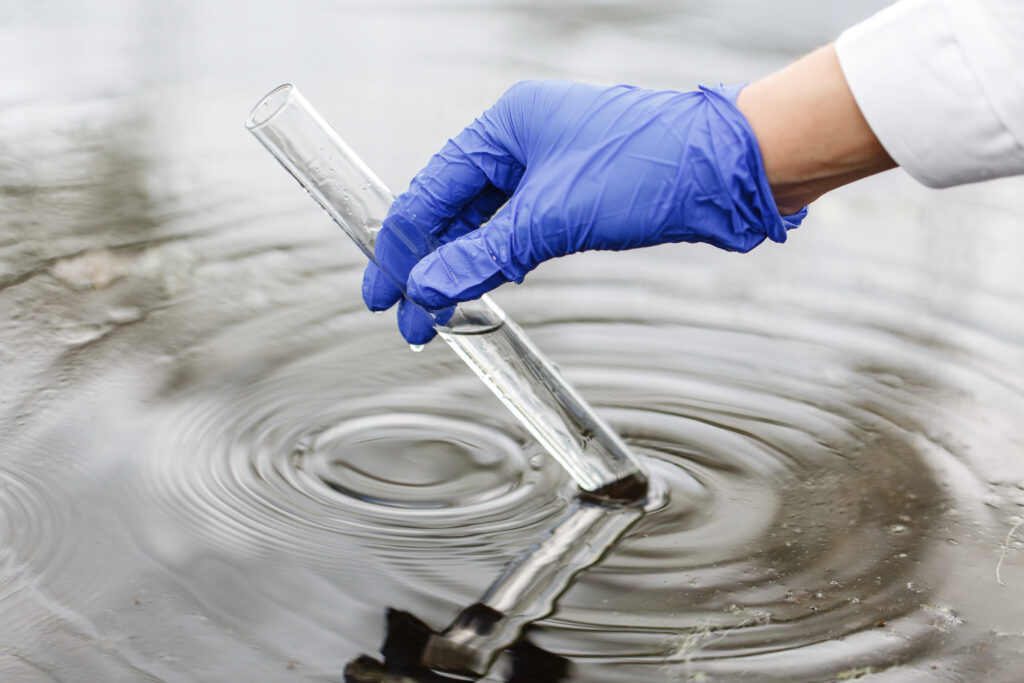
Part of his thesis project involved developing innovative materials to address environmental issues such as water quality, a major public health concern. Today, many industrial pollutants contaminate waterways, such as cobalt ions (Co²⁺) derived primarily from batteries, pigments, and alloys. To monitor water quality in the environment, scientists lack simple, portable tools capable of rapidly detecting these metal-based pollutants without resorting to costly laboratory analyses.

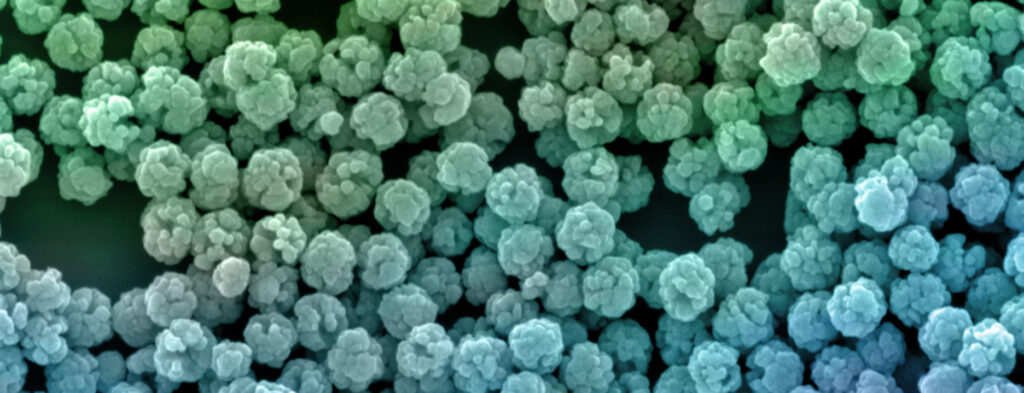
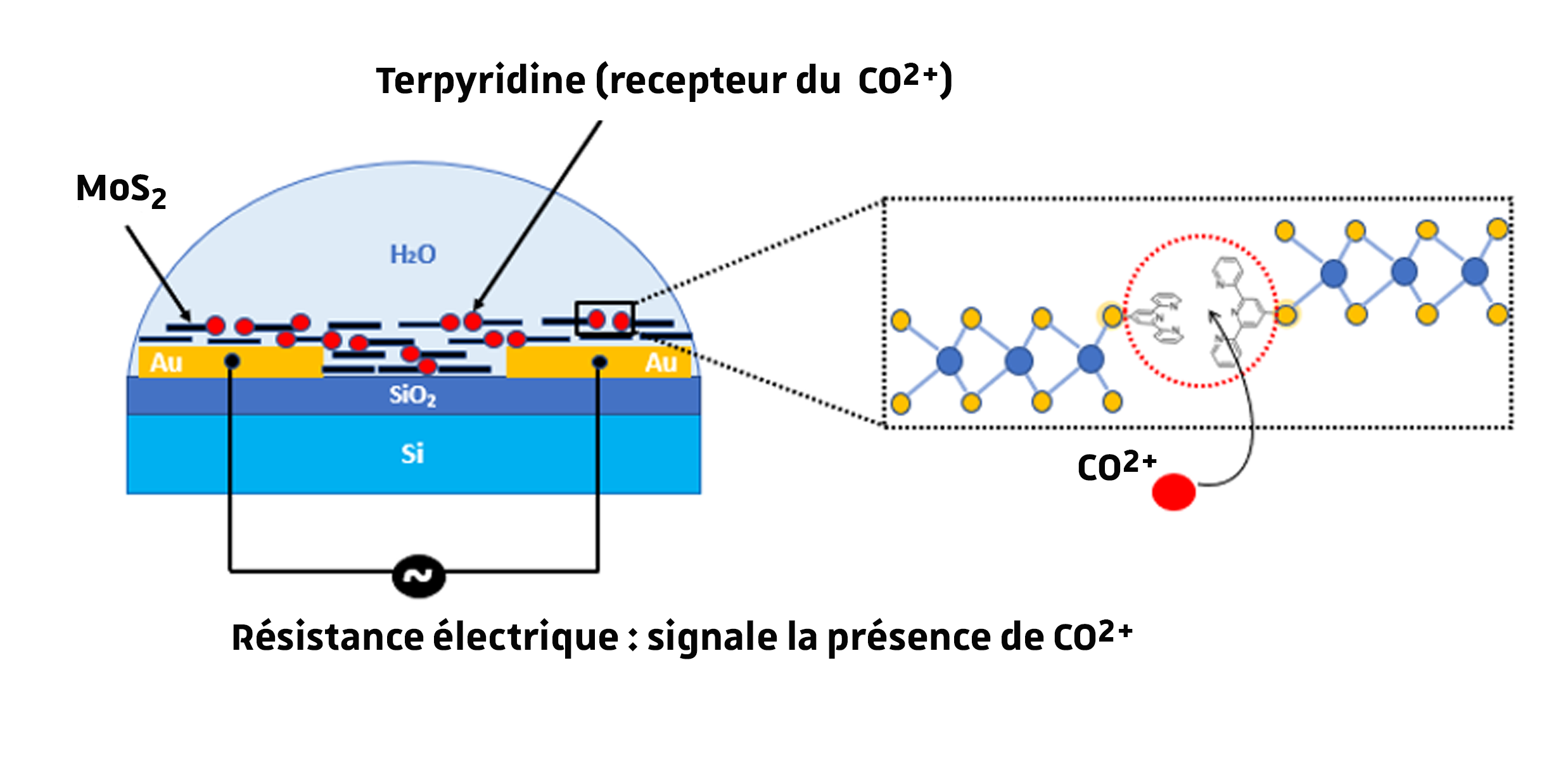
In her dissertation, the researcher explains that she developed an innovative device to specifically detect Co²⁺ ions: “This new sensor is based on a nanomaterial called MoS₂, a semiconductor composed of very thin layers, onto which molecules containing a terpyridine moiety have been grafted; these molecules selectively bind to Co²⁺ ions. When the water being tested contains this pollutant, even in very small quantities, the Co²⁺ ions bind to the material and locally alter charge transport in the MoS₂ film treated with the solution, which changes its electrical resistance and produces a signal that we can easily detect. Detecting Co²⁺ ions is difficult,

because they are chemically very similar to other metal ions, which interferes with the signal from a nonspecific sensor. “Here, with this device, we have succeeded in detecting Co²⁺ ions with very high specificity—and not other ions in solution—which is a successful proof of concept. Using this general method, we will be able to develop other similar devices to detect other pollutants, or even multiple compounds at the same time.”

This ingenious device was the subject of a publication in 2023, and this work earned Anna Zhuravlova the European Materials Research Society (E-MRS) Young Researcher Award in 2024. This remarkable achievement undoubtedly paved the way for her to attend the highly selective Lindau Meetings in Germany.

A top-tier international lineup to meet Nobel Prize in Chemistry laureates

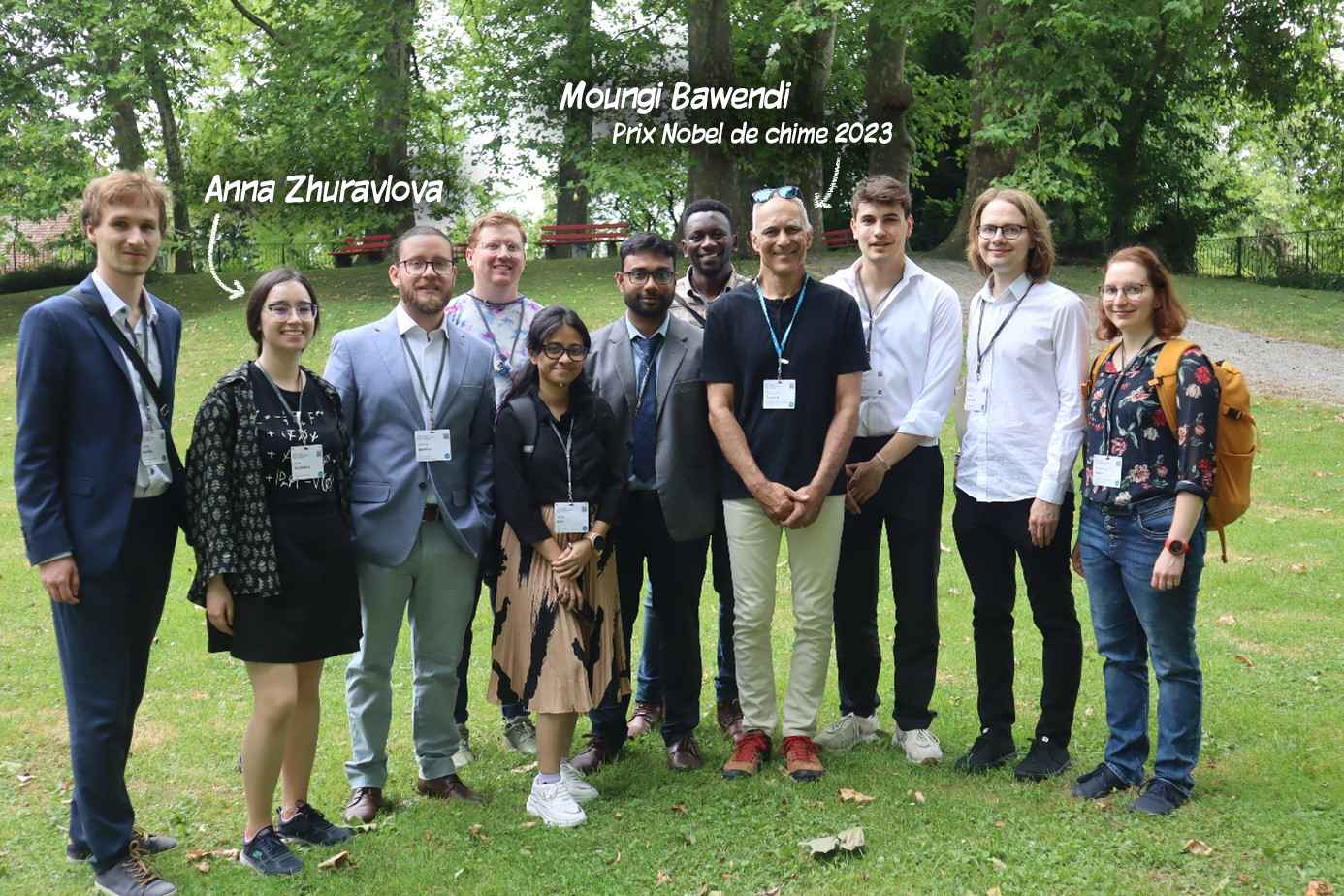
This international event is extremely selective: “Many of us want to have this experience, and there are several stages of selection; it was a true honor to have been chosen,” explains the researcher, who also presented her work to hundreds of participants attending the 74th edition of these meetings in Lindau. “There’s an incredible atmosphere—it’s very exhilarating. It’s surreal to meet such prestigious scientists, and at the same time, it’s reassuring to hear them simply explain that some of their discoveries happened by chance (the famous serendipity!). “It shows that they remain deeply human and approachable, far from the ‘superhero’ image we might have of them,” jokes the young researcher, noting that two encounters with Nobel Prize laureates were particularly memorable: “I was lucky enough to be part of a small group invited to talk with Moungi Bawendi, the 2023 Nobel Prize in Chemistry laureate who developed semiconductor nanoparticles known as ‘quantum dots,’ which are widely used in electronic displays. You might think we talked a lot about science, but that wasn’t all! Above all, it was an informal exchange about how he overcame certain challenges and how to balance a prestigious career with his personal life. He was approachable, and the conversation was very open. I was also impressed by Frances Arnold, the 2018 Nobel Prize laureate. Such an inspiring woman! Her field of researchisquite different from mine, but we were able to discuss the realities of this profession.”

What are the Lindau Nobel Laureate Meetings?


  • A prestigious annual scientific conference established in 1951. The 74th conference took place from June 29 to July 4, 2025, with a focus on chemistry.
  • This year: 606 young scientists ( undergraduate, master’s, doctoral, and postdoctoral students) from nearly 100 different countries. Among them, 11 French participants were selected to attend the event.
  • More than 30 Nobel laureates in attendance
  • Numerous events, including lectures by Nobel Prize laureates, informal discussion sessions between Nobel laureates and students, “NextGen Science sessions” where selected young scientists present their own research, and roundtable discussions focused on major current issues in science.

This event was also an opportunity to meet many talented young scientists with whom she was able to discuss what young scientists are experiencing today : “The challenges that early-career researchers may face are not necessarily the same as those that Nobel laureates faced 20 or 30 years ago.” “Exchanging ideas with my peers was one of the best parts of these meetings. Participating in this event allows you to join the Lindau Meetings alumni network—a great way to stay in touch and build a high-quality professional network. I encourage all young researchers to take a chance and seize this opportunity.”

Anna Zhuravlova defended her dissertation on September 4 and is continuing her work in the Nanochemistry Laboratory led by Paolo Samorì, her dissertation advisor: “I’ll be staying for 12 months to finalize a few other types of devices developed during my Ph.D.” After that, I’m determined to pursue a postdoc in a more fundamental field at the intersection of chemistry and physics. I had already aspired to pursue an academic career, but participating in the Lindau Meetings has further encouraged me to continue down this path! Being around all these inspiring scientists makes you feel that it’s possible, that you belong there and have a right to stay.” 

The motto of the Lindau Meetings is “educate, inspire, connect”—three promises that have clearly been fulfilled for this young, up-and-coming researcher.

September 4, 2025: Anna Zhuravlova after the defense of her dissertation, supervised by Paolo Samorì and Artur Ciesielski. From left to right: A. Ciesielski, A. Zhuravlova, Cécilia Ménard-Moyon (chair of the committee), P. Samorì.
Donation DONATIONS MAKE A DONATION