Supramolecular Hydrogels: Materials Inspired by Living Organisms for the Benefit of Medicine and the Environment
Composed primarily of water, supramolecular hydrogels are highly promising materials for a wide range of applications in the fields of health and the environment. For biomedical research, these gels offer a dual advantage: they have a flexible, biocompatible structure capable of interacting with cells, and therapeutic molecules can be incorporated into them for gradual release. From wound healing to 3D bioprinting, including controlled drug delivery, these next-generation hydrogels are paving the way for promising applications in healthcare. In the environmental sector, these materials can also incorporate other types of molecules, such as enzymes capable of breaking down pollutants in water.
As director of the SYCOMMOR research team at the Charles Sadron Institute in Strasbourg, Loïc Jierry takes a keen interest in these new materials: “The idea of modifying the surface of materials with therapeutic molecules is not new. Some approaches involve adsorbing these molecules—such as anti-inflammatory agents or antibacterial agents—onto the surface of medical implants placed in patients. Functionalizing materials layer by layer is an effective strategy, but it can be time-consuming and labor-intensive. Thanks to support from the Jean-Marie Lehn Foundation, we were able to design surface hydrogels capable of self-assembling, much like LEGO at the molecular scale. Molecules of interest with various applications can be added to make the hydrogel functional.” This biomimetic material assembles in the same way as the filaments found in living cells, which polymerize from the cell membrane.
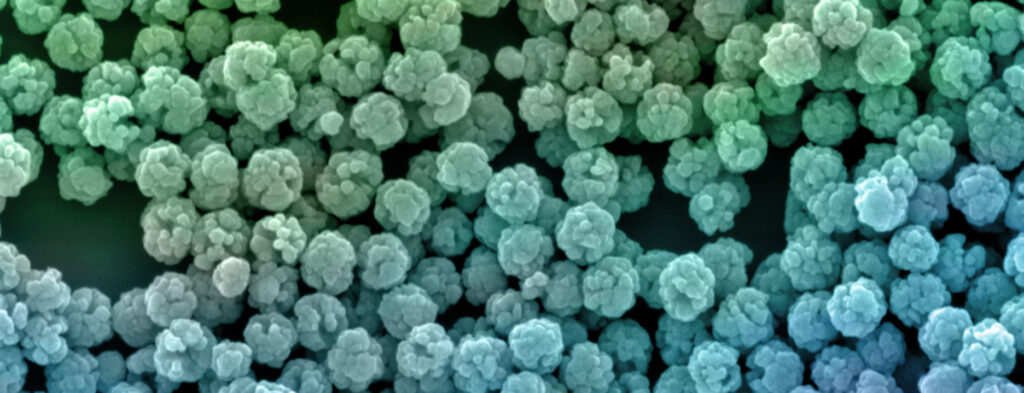
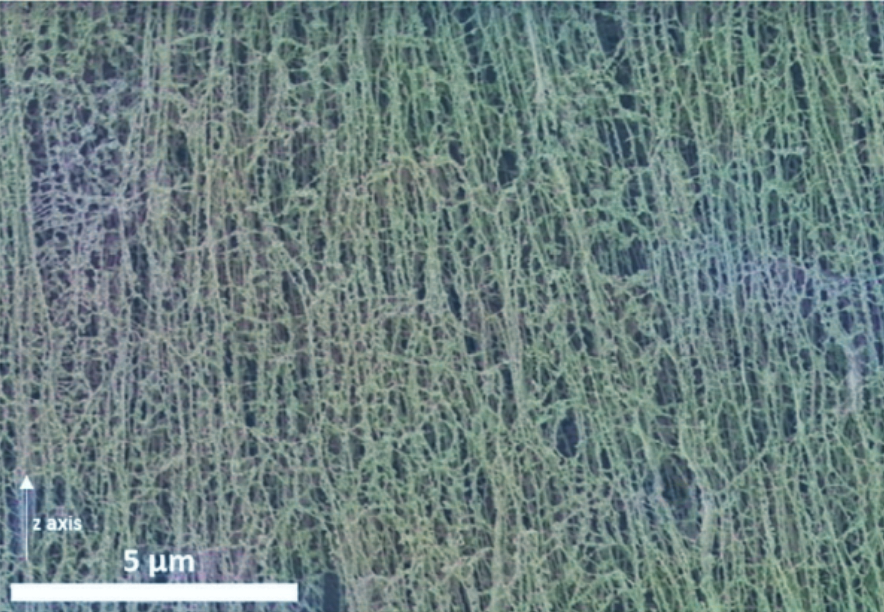
In collaboration with the team led by Pierre Schaaf—former Director of the INSERM Biomaterials and Bioengineering Unit and an associate researcher at the Charles Sadron Institute (CNRS)—as well as other collaborators, Loïc Jierry published anarticle¹ in 2024 describing the structure of these hydrogels: “Our supramolecular hydrogels are composed of peptides that self-assemble into nanofibers visible under an electron microscope, but we did not know their molecular-scale organization within these fibers. To find out, we used an imaging technique called cryo-electron microscopy, which involves cryogenically freezing our hydrogels to preserve them in their natural state. We then used, among other tools, artificial intelligence to analyze thousands of images of these fibers in order to model their molecular structure with high precision.”
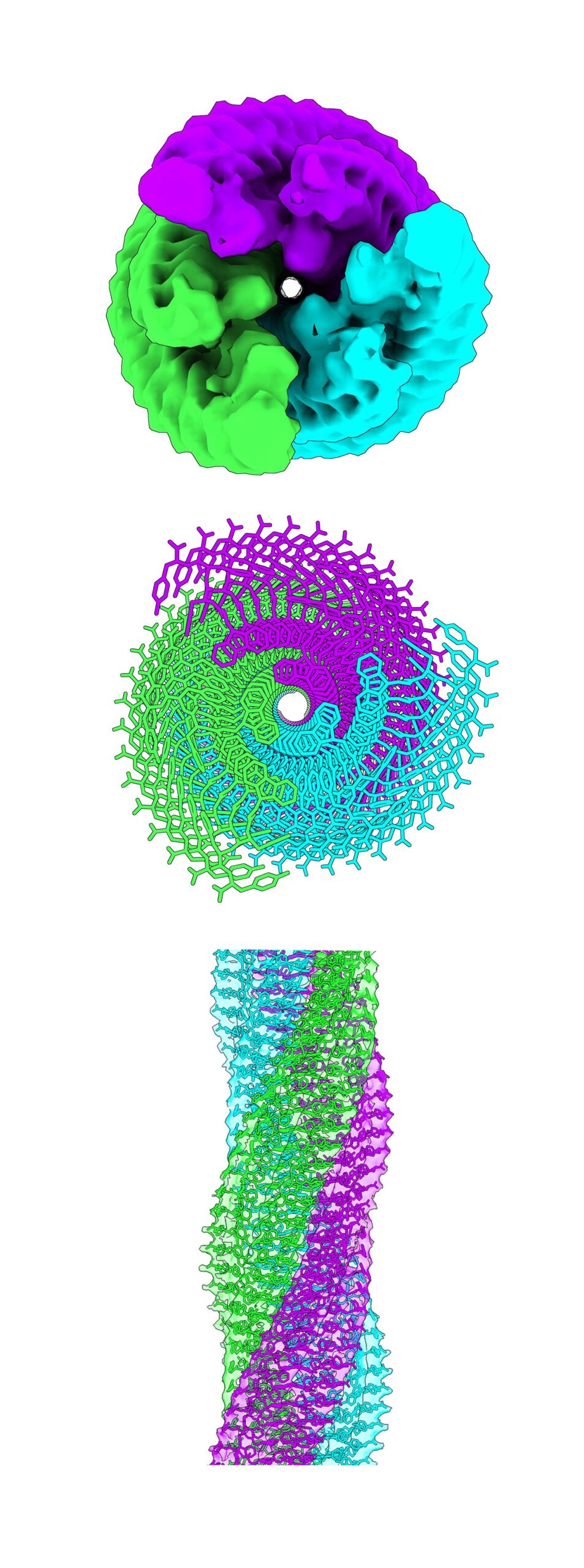
This publication describes the triple-helix shape of the fibers within the hydrogels and details their three-dimensional structure (Figure 1)—fundamental information for better understanding the interactions between the hydrogel and the various molecules that can be incorporated into the material. Another major advantage of these fibers is that they self-assemble without strong bonds (known as covalent bonds), allowing living cells embedded within them a wide range of motion. This inherent property of hydrogels makes them an ideal scaffold for tissue engineering and the creation of artificial organs.
That same year, the two teams also published an elegant demonstration of the usefulness of supramolecular hydrogels in the design ofbiocatalytic materials.²
In the chemical industry, such as the pharmaceutical industry, molecules are transformed by catalysts—often metals that can be toxic and harmful to the environment. Decontaminating these substances incurs costs, and manufacturers are taking a keen interest in biocatalysts—enzymes or catalytic peptides capable of carrying out the same chemical reactions in a non-toxic and non-polluting manner. Loïc Jierry explains why these catalytic peptides require a durable support for future industrial-scale applications: “Peptides that convert their substrate into a product need to be immobilized on a support, because they are expensive to produce and must be easily recoverable.” We have developed a support made from polymer foam whose pores are coated with a hydrogel based on self-assembled peptides, which results in catalytic activity. This innovative structure offers numerous advantages for applications in continuous-flow industrial processes: a pressurized liquid containing the substrate flows through the structure, which is fixed in a channel, passing through the pores of the foam. Once in contact with the peptide-based hydrogel, the liquid emerges loaded with the product of the catalytic reaction, all without dislodging the peptides, which remain within the hydrogel.” The demonstration was conducted using a biocatalytic hydrogel that converts a colorless substrate into a yellow product (Figure 2). This flow-through catalysis offers the advantage of continuously converting a given substrate into a product using few peptides, in adjustable quantities, and without requiring large amounts of reagents to be stored.
The commitment to developing solutions designed for industrial applications is essential for the researcher, who opened a joint CNRS laboratory with the company ALYSOPHIL in November 2024: “ActivIAflow is a laboratory that combines our expertise in the field of biocatalytic supramolecular hydrogels with the know-how of ALYSOPHIL, a company specializing in the design of microfactories based on flow chemistry and artificial intelligence. This company has developed strong expertise in generating molecules of interest using AI, a technology based on databases and algorithms they have developed. Their expertise thus enables them to propose structures capable of meeting the specific needs of the cosmetics or defense industries (new technical fuels, a molecule that smells like roses for a future perfume, etc.).” Once the molecule has been modeled and then synthesized, it can be tested and finally produced by these microfactories on a made-to-order basis.
Initially explored from a fundamental perspective, the development of these hydrogels—which have numerous applications—once again illustrates the importance of supporting ambitious research projects at the very early stages. The Jean-Marie Lehn Foundation is proud to be committed to this mission, which enables the emergence of innovative solutions as promising as those developed by Loïc Jierry’s team and its partners.
Sources
1. 3D Cryo-Electron Microscopy Reveals the Structure of a 3-Fluorenylmethyloxycarbonyl Zipper Motif That Ensures the Self-Assembly of Tripeptide Nanofibers. Alexis Bigo-Simon, Leandro F. Estrozi, Alain Chaumont, Rachel Schurhammer, Guy Schoehn, Jérôme Combet, Marc Schmutz, Pierre Schaaf, and Loïc Jierry. ACS Nano 2024 18 (44), 30448–30462. DOI: 10.1021/acsnano.4c08043
2. Supported Supramolecular Hydrogel Nanoarchitectonics for Tunable Biocatalytic Flow Activity. Shahaji H. More, Jean-Yves Runser, Aymeric Ontani, Jennifer Rodon Fores, Alain Carvalho, Christian Blanck, Christophe A. Serra, Marc Schmutz, Pierre Schaaf, and Loïc Jierry. Small 2024, 2405326. DOI: 10.1002/smll.202405326
Our articles on the same topic