Highly Sensitive Sensors to Prevent Cardiovascular Diseases
Cardiovascular diseases are the leading cause of death worldwide; they are preventable when detected early. Paolo Samorì’s laboratory has developed a new generation of ultra-sensitive sensors that can be used, among other things, to collect health data. This type of device can provide an early warning at the very first, imperceptible signs of a developing cardiovascular disease. This new-generation sensor, combined with the analytical power of artificial intelligence, is a promising tool for prevention and diagnosis.
Health Data Collection and Analysis: The Future of Prevention
The rise of artificial intelligence is opening up numerous opportunities in the field of diagnostics: analyzing patients’ medical data at regular intervals makes it possible to personalize long-term care, track each individual’s typical health indicators (blood pressure, heart rate, blood and respiratory markers, etc.), and detect early signs of abnormalities that may indicate an impending disease.
When it comes to cardiovascular diseases, blood pressure and pulse measurements are already being collected by some smartwatches to monitor high blood pressure or detect heart rhythm disorders. But this type of technology could go even further: other conditions could be diagnosed using ultra-sensitive pressure sensors capable of detecting minute changes in blood flow. These atypical microvariations, when compared to the baseline previously measured for each individual, could reveal the development of stroke, coronary artery disease, or heart failure due to the buildup of fatty deposits in the artery walls.
Ultra-sensitive graphene-based sensors
As early as 2016, Professor Paolo Samorì (director of the Nanochemistry Laboratory at the Institute of Supramolecular Science and Engineering) recognized the potential of this type of sensor. As a specialist in the design of smart supramolecular materials, his laboratory embarked on the development of a new type of graphene-based sensor. Paolo Samorì explains the innovative principle behind this material: “To detect pressure, we devised a material composed of several layers of graphene (an assembly of carbon atoms in the form of a conductive sheet), separated by insulating molecular springs (Figure 1). Mechanical pressure brings the graphene layers closer together and allows
an electric current to flow from one layer to the other. The variation
in pressure is then detectable and quantifiable by measuring the
electric signal detected on the material’s surface.”
Figure 1: Illustration of graphene layers (in gray) separated by molecular springs (in blue).
The team tested several “spring” molecules of varying stiffness, enabling the production of a range of sensors with different pressure detection sensitivities. For potential healthcare applications, the heartbeat could then be detected by placing this device directly on the skin, near key blood vessels. The device was tested on about ten patients at the Turin hospital to measure pulse wave velocity in real time. This is a very important indicator for monitoring a patient’s cardiovascular health, as it serves as a predictive parameter, thereby providing a true diagnosis. This validated proof of concept points to future use in patients’ daily lives and offers an alternative to current equivalent devices, which are very expensive and can only be operated by doctors. Although promising, this material has a limitation that the professor quickly identified: “The nature of the springs limits the material’s detection capability. This type of sensor cannot measure a very wide range of pressure, so we had to develop something else.”
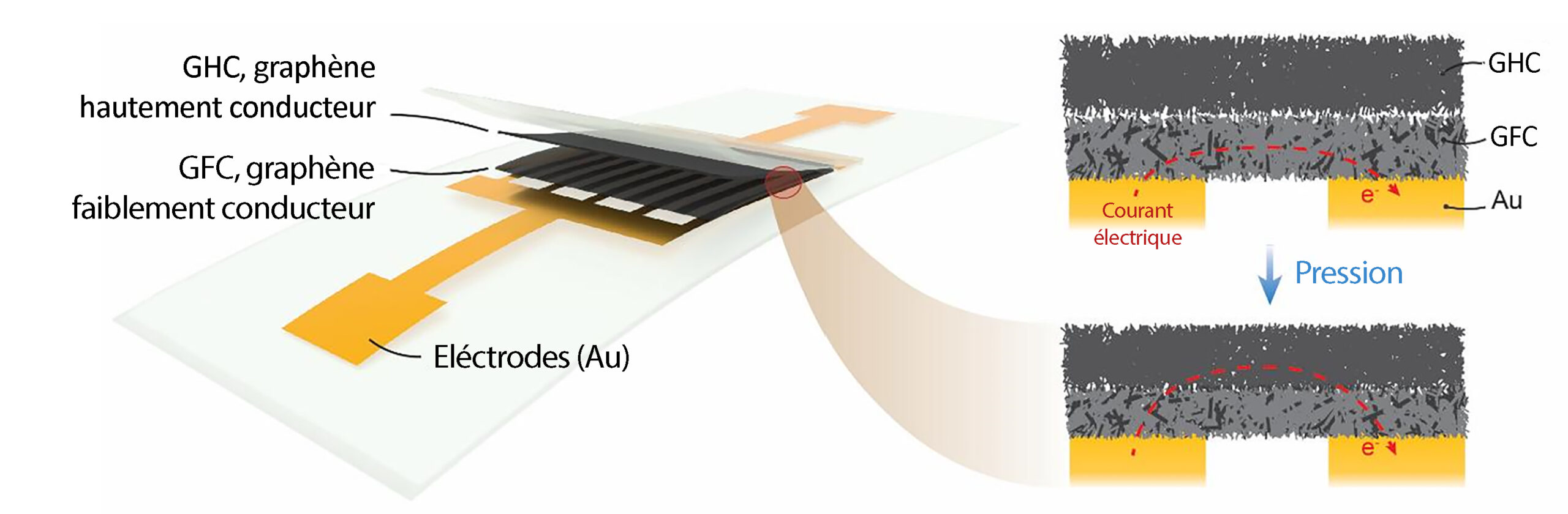
The team then devised a new system also based on converting mechanical pressure into detectable electrical energy, but with a different structure and different components. A new doctoral student in the Nanochemistry Laboratory, Feng Luo, replaced the layers of graphene sheets and springs with two graphene-based layers of different compositions: a highly conductive top layer and a compressible, less conductive bottom layer. Electrodes are placed in contact with the lower layer to allow an electric current to flow (Figure 2). “When no pressure is applied, the electric current flows only through the lower, less conductive layer. When pressure is applied, the layers compress and come into closer contact. The electrons then favor pathways through the more conductive upper layer to flow between the electrodes, causing the resistance to drop. By measuring this electrical variation, we can detect and quantify the applied pressure, ” explains the enthusiastic researcher. “With this system, it’s possible to measure, with maximum precision,minutepressures equivalent to the vibration of an eardrum exposed to sound, as well as the pressure exerted by a 100-kilo man on a scale!”
Figure 2: Schematic and photograph of the sensor. Under the effect of the applied pressure, the path taken by electrons as they travel from one gold (Au) electrode to the other shifts from the lower layer (GFC, low-conductivity graphene) to the upper layer (GHC, high-conductivity graphene). The higher the pressure, the stronger the electrical current measured at the output.
Professor Samorì’s laboratory is currently working on improvements to further refine the accuracy of their sensors’ measurements: “So that this type of pressure sensor—such as those used for cardiovascular monitoring—can one day be used in a real-world setting (such as at home) for daily measurements, we are currently working to neutralize the impact of ambient temperature on the reliability and reproducibility of the measurements.”
These sensors will not only be useful for preventing cardiovascular disease; they may also prove very useful for monitoring a wide range of physiological and mechanical signals to provide valuable information—for example, on sleep quality and posture.
Overall, portable pressure sensors such as those developed at the Institute of Supramolecular Science and Engineering (ISIS) will play a key role in the medicine of the future, where the daily monitoring of numerous physical and chemical signals will enable the early diagnosis of many diseases.
Figure 3. Device under development in Paolo Samorì’s laboratory: precise detection of the force and location of pressure applied to multiple sensors.
Research made possible by funding that rewards boldness
In 2016, the Solvay Group decided to provide €500,000 in support to the University of Strasbourg to enable the development of top-tier research projects. The Jean-Marie Lehn Foundation then backed the initiative and contributed an additional €400,000 to the Solvay fund. Paolo Samorì was one of the first recipients of this program with his project on ultrasensitive sensors: “I had never developed pressure sensors when I applied for this call for proposals with Chang-Bo Huang, the brilliant Ph.D. student who developed the first device; it was a very uncertain, highly fundamental project at the outset. I’m sure that traditional funding agencies would have been much more hesitant.” This project once again illustrates the need to support exploratory research. Through their initial funding, Solvay’s generosity and the Jean-Marie Lehn Foundation’s confidence made it possible to kickstart the development of innovative sensors that are now opening up new possibilities in healthcare.
Our articles on the same topic