A non-invasive technology for assessing the allergenic potential of chemical compounds found in cosmetics

Published on October 21, 2025

Allergic contact dermatitis, a common condition that is all too often linked to the use of cosmetics, is a skin disease that is difficult to prevent. In Strasbourg, Elena Giménez-Arnau, Research Director at the CNRS at the Strasbourg Institute of Chemistry (UMR 7177), is developing a non-invasive and innovative method to assess the allergenic potential of chemical compounds that may cause this condition through free-radical mechanisms—a technology that is essential for ensuring consumer safety.

Allergic contact dermatitis: a common cutaneous immunotoxicity reaction associated with skin contact with xenobiotics

Allergic contact dermatitis, also known as contact eczema, is a localized inflammation of the skin triggered by contact with certain substances, such as molecules found in cosmetics or fragrances. Approximately 20% of the general population is sensitized to at least one contact allergen, ¹ a trend that has been on the rise for several years and correlates with the increase in the consumption of cosmetic products—a booming market. Skin care products, sunscreens, hair lotions, perfumes, makeup… many products—particularly those popularized by beauty influencers on social media—may contain one or more molecules that cause contact dermatitis.

The cosmetics industry faces strict regulations in Europe governing the toxicity of chemical compounds found in consumer products. Among these problematic molecules, some are found to be allergenic or irritating only when exposed to sunlight. Among the range of tools used to test cosmetics and their ingredients, none has yet been validated to assess photoallergenic molecules and distinguish them from photoirritating molecules.

A researcher in Strasbourg is studying the chemical and molecular mechanisms of allergic contact dermatitis

Elena Giménez-Arnau specializes in the study of the chemical and molecular mechanisms underlying skin sensitization and contact allergy induced by substances foreign to the body (known as xenobiotics). As a member of the “Optical and Magnetic Properties of Molecular Architectures” (POMAM) laboratory in Strasbourg, she works at the intersection of chemistry and biology. 

“These skin reactions are very specific allergies for which there is no treatment other than avoiding the allergenic substances. Unlike food or respiratory allergies, different components of the immune system are involved, and desensitization is not possible,” explains the researcher, emphasizing the importance of regulating the molecules used in cosmetics. “The immunotoxicity process characteristic of allergic contact dermatitis begins when the allergenic molecule interacts with skin proteins to form an antigenic entity (that is, a molecular complex recognized as foreign by our immune system). This entity then activates the immune system, which triggers a defensive reaction upon subsequent contact with the allergen. In the case of certain allergenic molecules, this reaction with skin proteins occurs through the formation of free radicals—unstable molecules that are highly reactive and can react with skin proteins, thereby inducing sensitization.”

For many years, Dr. Giménez-Arnau has been studying the free-radical mechanisms that trigger skin dermatitis, in close collaboration with Dr. Bertrand Vileno, also a researcher at PONAM. Recently, she has focused specifically on photoallergic and photoirritant reactions triggered by sun exposure. “Certain cosmetics, perfumes, and even over-the-counter medications can trigger severe inflammatory skin reactions when exposed to the sun. This is the case with ketoprofen, a nonsteroidal anti-inflammatory drug used in creams for muscle and joint pain, as well as with certain sunscreens used in cosmetic products,” the researcher warns, noting that some products labeled “natural” may seem safer but can still contain allergenic compounds when exposed to the sun.

Elena Giménez-Arnau points out that it is not always the same types of free radicals that trigger skin reactions: “Oxygen-derived radicals (known as ROS) are already known to play a role in skin aging and have been identified as the cause of photoirritant dermatitis (an immediate reaction resulting in redness, a burning sensation, and itching). Carbon-centered radicals, on the other hand, may be responsible for photoallergic dermatitis (a delayed reaction that can lead to eczema, blisters, or patches).” These are two types of reactions that manufacturers must be able to identify when testing their products, and Elena Giménez-Arnau’s laboratory has focused on them to develop new tests that are essential for consumer safety.

Funding from the Lehn Foundation to develop a screening test for photoallergenic and photoirritant substances

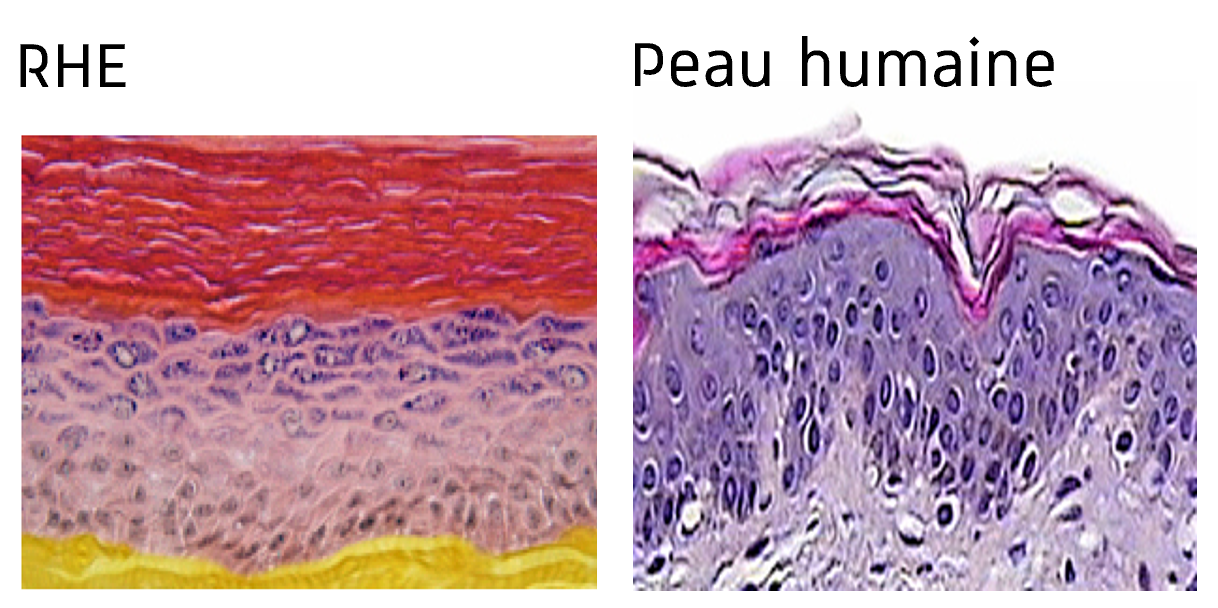
In 2024, Elena Giménez-Arnau’s laboratory published original research 2 in which the authors experimentally demonstrated the generation of free radicals from photoallergens in a skin model. “In this study, we used reconstituted human epidermis. It is a 3D skin model that simulates the structure of the human epidermis using real human cells in culture, very close to reality (Figure 1),” explains the researcher, noting that this technology makes it possible to avoid animal testing, which is banned in Europe in the cosmetics industry.

Figure 1: Microscopic view of Reconstructed Human Epidermis (RHE) and human skin. The nature of the cells and their structure are very similar.
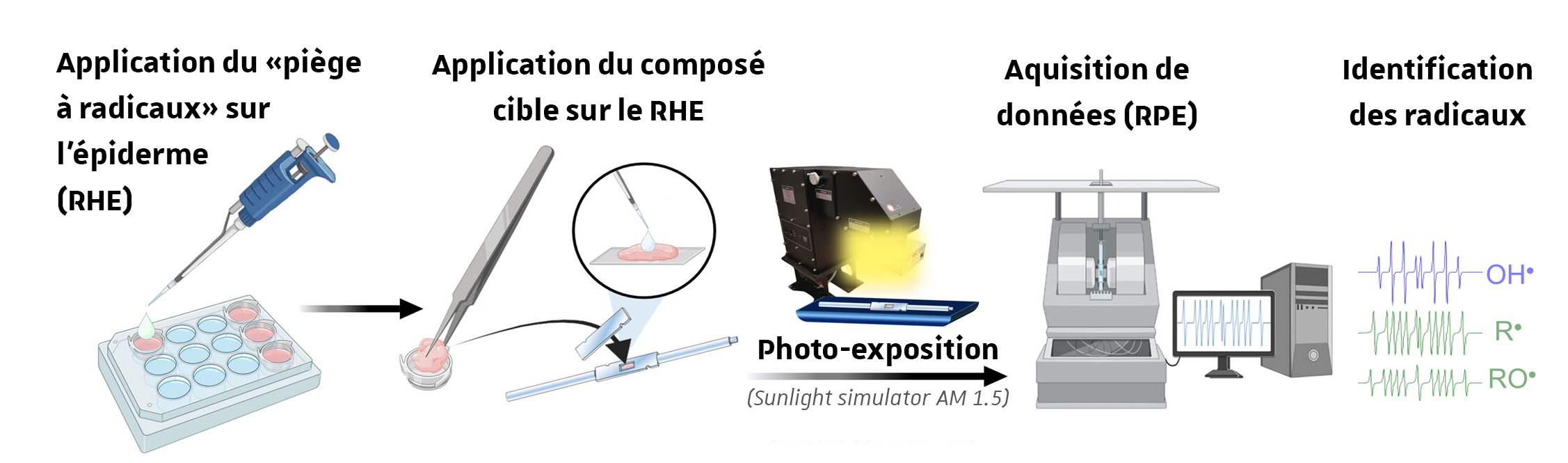
“The reconstructed human epidermis is placed in a flat-bottomed cell and treated with substances suspected of having photoirritating or photoallergenic effects in the presence of light. The challenge lies in detecting the radicals produced, as they are, by definition, unstable intermediates that are difficult to capture. We therefore used a technique called ‘spin trapping’: the reconstructed human epidermis is first treated with a compound called a ‘radical trap’ that captures the radicals produced by the (photo)allergen, forming a stable product that can then be detected by Electron Paramagnetic Resonance (EPR). “Using this method, we can identify the radicals generated in the skin tissue for each substance upon exposure to light” (Figure 2).
Figure 2: Details of the testing protocol: A “spin trap” compound is applied to Reconstituted Human Epidermis (RHE) samples and then incubated for 15 minutes at 37°C. The RHE is then placed on a flat cell, the test molecule is applied to the surface, and the sample is exposed to radiation using a solar simulator. The sample is then analyzed by Electron Paramagnetic Resonance (EPR), and the results indicate the presence (or absence) of free radicals formed, as well as their nature.

This project got its start when Elena Giménez-Arnau won a grant competition organized by the Jean-Marie Lehn Foundation, which is designed to support ambitious projects led by young researchers seeking to develop their own research topics independently of their lab directors. “At the time, I was a research fellow, and this funding allowed me to recruit a brilliant Ph.D. student who developed this technology. It was a wonderful opportunity to embark on an exploratory project that proved to be promising. Since then, I became a Research Director in 2020, and this year I was able to secure new funding from the Foundation to develop these tests and produce a solid proof of concept to make this method scalable and usable by the cosmetics industry.” This latest funding will enable the purchase of a spectrometer specifically designed for research conducted at the POMAM laboratory at the interface of chemistry and biology, and will strengthen the team through new hires.

The development of this method highlights the importance of early-stage funding not only for gaining a better understanding of the mechanisms underlying this skin condition, but also for developing diagnostic solutions that are essential to the health of the many consumers of cosmetic products.

Sources: 

1.      Prevalence of contact allergy in the general population: A systematic review and meta-analysis. Alinaghi F, Bennike NH, Egeberg A, Thyssen JP, Johansen JD. Contact Dermatitis. 2019 Feb;80(2):77-85. doi: 10.1111/cod.13119. Epub 2018 Oct 29. PMID: 30370565. https://pubmed.ncbi.nlm.nih.gov/30370565/

2.      Probing skin photoallergens in reconstructed human epidermis: An EPR spin-trapping investigation. Yannick Port-Lougarre, Guillaume Voegeli, Bertrand Vileno, Elena Gimenez-Arnau, August 27, 2024, https://doi.org/10.1111/php.14010

Donation DONATIONS MAKE A DONATION