
Molecular motors: remarkable new discoveries that deepen our understanding of living organisms

Published on November 8, 2024

For many years, the mystery of molecular motors has fascinated scientists around the world. In 2016, the Nobel Prize in Chemistry was awarded to Jean-Pierre Sauvage of France, professor emeritus at the University of Strasbourg; J. Fraser Stoddart of the United Kingdom; and Bernard L. Feringa of the Netherlands for their work on the design and synthesis of artificial molecular machines. Building on this work, researchers from the Charles Sadron Institute (University of Strasbourg/CNRS) and the University of Manchester recently published an article in the prestigious scientific journal *Nature* that provides a long-awaited explanation of how these motors function. This study demonstrates how simple motors can convert a source of chemical energy into mechanical work through a catalytic process. This remarkable breakthrough will lead to a better understanding of certain biological processes essential to the functioning of living cells and pave the way for innovative applications.

To better grasp the significance of this discovery, it is essential to understand what a molecular motor is. According to Professor Nicolas Giuseppone, director of the Molecular and Supramolecular Synthesis and Self-Assembly team, “A typical molecule in a cell, like a swimmer in rough seas, finds itself in the water unable to steer and is buffeted by the force of the waves. Molecular motors, on the other hand, behave like surfers; they harness the energy of specific, carefully selected waves to orient themselves and produce perfectly controlled movement. Molecular motors thus use the disorder of their environment to generate ordered motion and perform useful mechanical work.” In nature, molecular motors are numerous and perform essential functions: DNA replication and translation, movement within cells or tissues, and cell division. To do this, these biological motors consume a source of chemical energy (usually ATP) through enzymatic pathways and convert it into mechanical work. However, the precise mechanism capable of generating force from a molecular reaction is the subject of much debate.

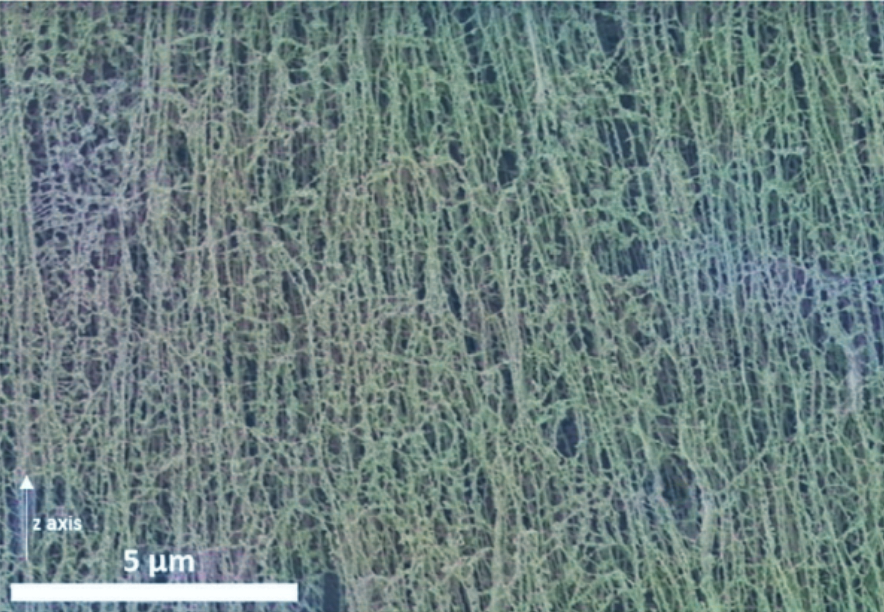
As part of the European collaborative project ITN-ArtMoMa, Nicolas Giuseppone’s team in Strasbourg and David Leigh’s team in Manchester have succeeded in demonstrating this mechanism using a minimal chemical system. They combined rotary motors—1,000 times smaller than natural ones—within a polymer network. “We have shown that these motors act as catalysts and vice versa. The transformation of a chemical fuel allows them to extract an energy source that they use to direct their movements in a given direction. Catalysis does not directly produce force, but the chemical energy allows us to select the motor’s random movements so that it rotates in one direction rather than another, and that is what produces directional work. So chemical energy is converted into mechanical energy. This is the first time this phenomenon has been proven,” says Nicolas Giuseppone.

A Wide Range of Opportunities in Health and Beyond!

In their experiments, the scientists connected a very large number of motors so that they would operate simultaneously. Their movements were thus amplified within the polymer network to the macroscopic scale, and the force generated within the material could be measured and correlated with catalytic activity. This opens the door to potential applications in a wide range of fields. The force generated by these molecular motors could propel objects within the body—to deliver drugs, for example—or create muscle implants that use cellular energy as fuel. “Wherever there is movement, molecular motors could be useful. We can imagine these motors being integrated into materials that become active at all scales. This will have an impact on the fields of nanotechnology, materials and biomaterials, and soft robotics,” explains Nicolas Giuseppone.

The Strasbourg team is just beginning to work on applications. “We recently published a paper showing that molecular motors can destroy, in vitro, models of beta-amyloid fibers, which are responsible for Alzheimer’s disease,” the researcher explains. On a completely different front, scientists are focusing on the use of photoactivatable motors to generate supramolecular polymers with dynamic properties. This paves the way for applications in the field of self-healing and recyclable materials, especially since this technology simply uses light as a non-polluting energy source.

Reference

" Transducing Chemical Energy Through Catalysis by an Artificial Molecular Motor
" *Nature* 637, 594–600 (2025). https://doi.org/10.1038/s41586-024-08288-x

https://www.nature.com/articles/s41586-024-08288-x

Donation DONATIONS MAKE A DONATION