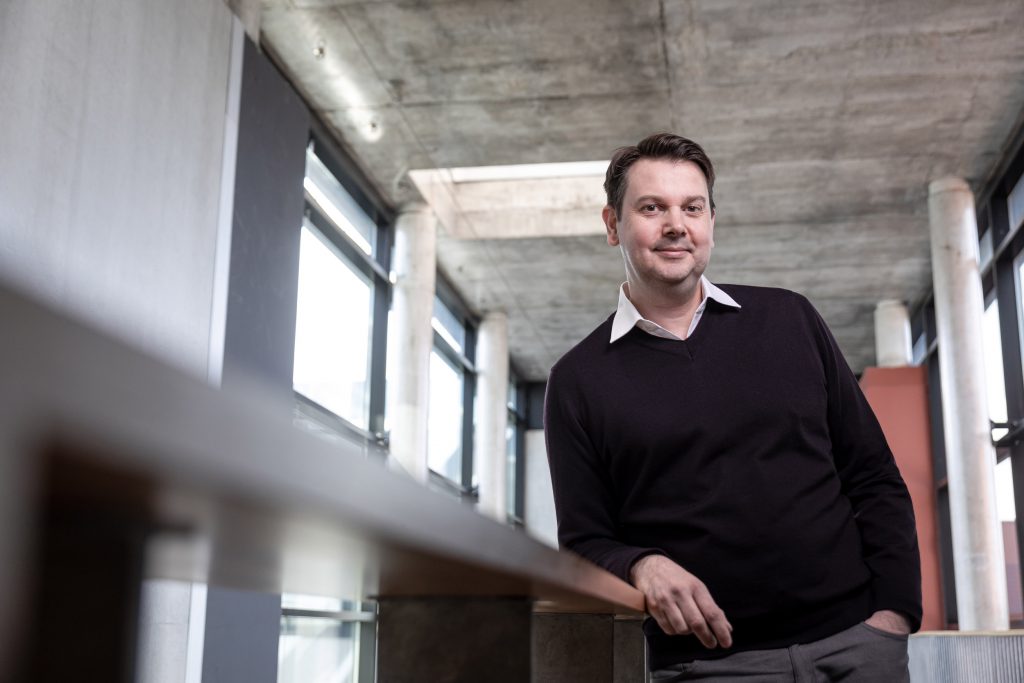
Jean-François Lutz, co-recipient of a 20M€ grant to revolutionize data storage.
The MoleculArXiv Project at a Glance
7-year financing: €20 million
4 targeted projects:
- DNA Synthesis
- Digital Data as the Foundation of DNA
- Digital Synthetic Polymers
- Applications
7 laboratories involved in the third targeted project:
- 4 University of Strasbourg (ICS, IPHC, IGBMC, and Lima)
- 1 University of Haute-Alsace (IS2M)
- 1 University of Evry (Lambe)
- 1 Aix-Marseille University (ICR)
Project Management for the Polymers Initiative: Jean-François Lutz
In Search of the Hard Drive of the Future
Researchers made a simple observation: the DNA molecules in a single cell can store a very large amount of information (the blueprints needed to recreate an entire organism—nothing less). One gram of DNA has a storage capacity of455×10¹⁸ bits , so it would take only about 140 grams of DNA to store the 64 zettabits of data stored on servers worldwide in 2020 ! All of this without the need for cooling or an external energy supply.
Another advantage: long-term stability. Traditional storage is not very durable : data archived on disks or magnetic tapes must be transferredapproximately every 10 years³, whereas DNA (under certain conditions) takes several hundred thousand years to degrade atroom temperature⁴.
One of the main focuses of the MoleculArXiv project will be to develop DNA-based data storage, but Jean-François Lutz had another idea—and he had it almost 10 years ago: replacing the DNA molecule with polymers that are easier to handle.
Information Stored Directly Within the Plastic Itself
These promising prospects are being explored in a second strand of the MoleculArXiv project, led by Jean-François Lutz. The researcher also notes that the space savings offered by this type of storage would make it possible to store “ all of human knowledge in a room measuring just a few cubic meters ”1.
Converting Computer Data
Binary Number System:
Sequences of 0s and 1s (bits)
Composed of at least 2 different monomers, each assigned a value of 0 or 1 (storage density of 1 bit per monomer).
Augmented alphabets can also be used:
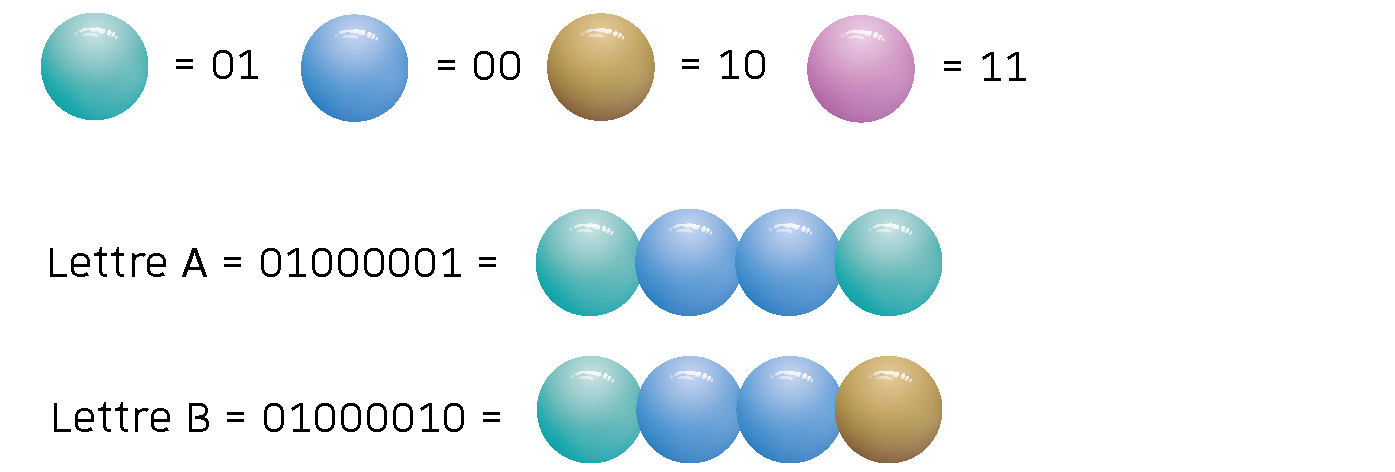
When four different monomers are used, they can be assigned the values 00, 01, 10, and 11 (storage density of 2 bits per monomer).
When 8 different monomers are used, they can be assigned the values 000, 001, 010, 100, 011, 101, 110, and 111 (storage density of 3 bits per monomer).
DNA
DNA is composed of four nucleotides: adenine (A),
thymine (T), cytosine (C), and guanine (G).
Like polymers, each base can be associated with 1 or 2 bits according to the same principles.
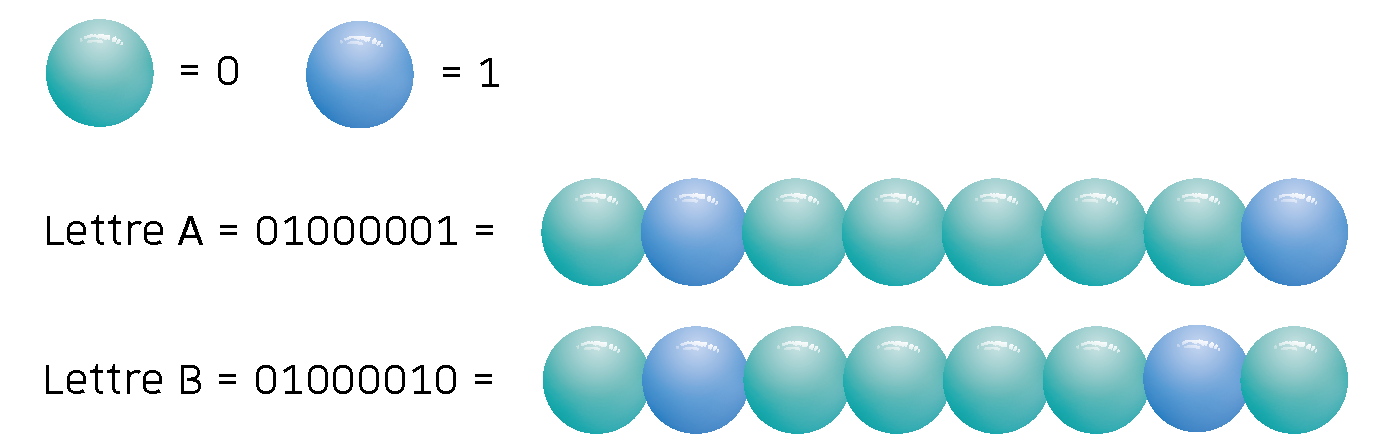
Each letter of the alphabet is encoded using 8 bits, or one byte.
The letter A in binary = 01000001; the letter B = 01000001
When two monomers are used for encoding, the letter A or B is stored in a sequence of 8 monomers:
When four monomers are used for encoding, the letter A or B is stored in a shorter sequence of only 4 monomers:
The main obstacle: data accessibility
In fact, to extract information stored in DNA, sequencing equipment is required, and thethe process is slow and costly. Reading polymers is also far from instantaneous and requires the use of a mass spectrometer. In 2017, the laboratory of Jean-François Lutz’s laboratory (in collaboration with the Institute of Radical Chemistry in Marseille) set a world record for the amount of information that can be sequenced using mass spectrometry5. These results, published in the journal *Nature Communications*, have earned the French researchers a solid international reputation, a significant French strength in this strategic area of research.
Today, this type of storage appears well-suited for archiving so-called “cold” data (i.e., data that is accessed infrequently). In the future, as equipment for synthesizing and reading these polymers improves, this type of storage medium could well revolutionize the sector.
A strategic program to position France as a leader in this cutting-edge technology
Officially launched in January for a seven-year term and funded to the tune of 20M€, this project is led by the CNRS as part of the exploratory Priority Programs and Equipment (PEPR) initiative.
This highly selective program aims to assemble teams from French laboratories to address key challenges in highly strategic research areas, such as environmentally friendly digital technologies.⁶ The exploratory PEPRs represent 1 billion euros that will be invested to establish or strengthen French leadership in priority scientific fields linked to large-scale transformation—whether technological, economic, societal, health-related, or environmental.
Sources
- https://recherche.unistra.fr/actualites-recherche/actualites-de-la-recherche/polymeres-synthetiques-numeriques-stocker-le-savoir-humain-dans-une-seule-piece
- https://www.futura-sciences.com/tech/breves/informatique-data-centers-sont-gouffre-energetique-voici-reduire-leurs-emissions-tiers-5420/
- https://theconversation.com/ladn-sera-t-il-lavenir-du-stockage-de-donnees-159387
- https://www.franceculture.fr/sciences/adn-et-stockage-de-donnees-vers-une-future-bibiotech
- https://www.cnrs.fr/fr/record-du-monde-pour-la-lecture-de-plastiques-numeriques
- https://www.gouvernement.fr/recherche-programmes-et-equipements-prioritaires-de-recherche-3-milliards-d-euros-mobilises-pour-la
Our articles on the same topic