An innovative material captures CO2 and industrial contaminants
Organometallic materials with fascinating properties and promising environmental applications have been developed at the University of Strasbourg and the CNRS. Here’s a closer look at this new technology, which aims to make our industries cleaner.
New materials with great potential
In this era of ecological transition, making industrial manufacturing processes more sustainable and less harmful to the environment has become a priority—one that has not gone unnoticed by researchers.
Many laboratories are working to develop innovations capable of combating two types of pollution: greenhouse gas emissions and the release of pollutants. Metal-organic frameworks (also known as MOFs) are characterized by their structure of ordered pores of uniform size, a property known as adsorption that allows them to trap specific compounds on their surface, such as pollutants or evenCO2 (one of the main greenhouse gases responsible for climate change).
Benoît Louis, a researcher at the Institute of Chemistry and Processes for Energy, the Environment, and Health (ICPEES), and Jean-Marc Planeix, a faculty researcher at the Molecular Tectonics Laboratory: Organic and Organometallic Molecular Networks, have decided to combine their expertise to conduct research focused on the design and application of new MOFs. The goal of their research is toprovide solutions to various challenges of this transition.
While these materials are certainly promising, they have one major drawback: most are unstable in water, where they lose their adsorbent properties. “TheCO2 emitted from large factory smokestacks is always accompanied by water vapor and other contaminants. Their presence makes it impossible to use MOFs under these conditions, ” explains young researcher Nizami Israfilov, who was hired in 2019 to lead this project.
A talented young researcher to take on the challenge
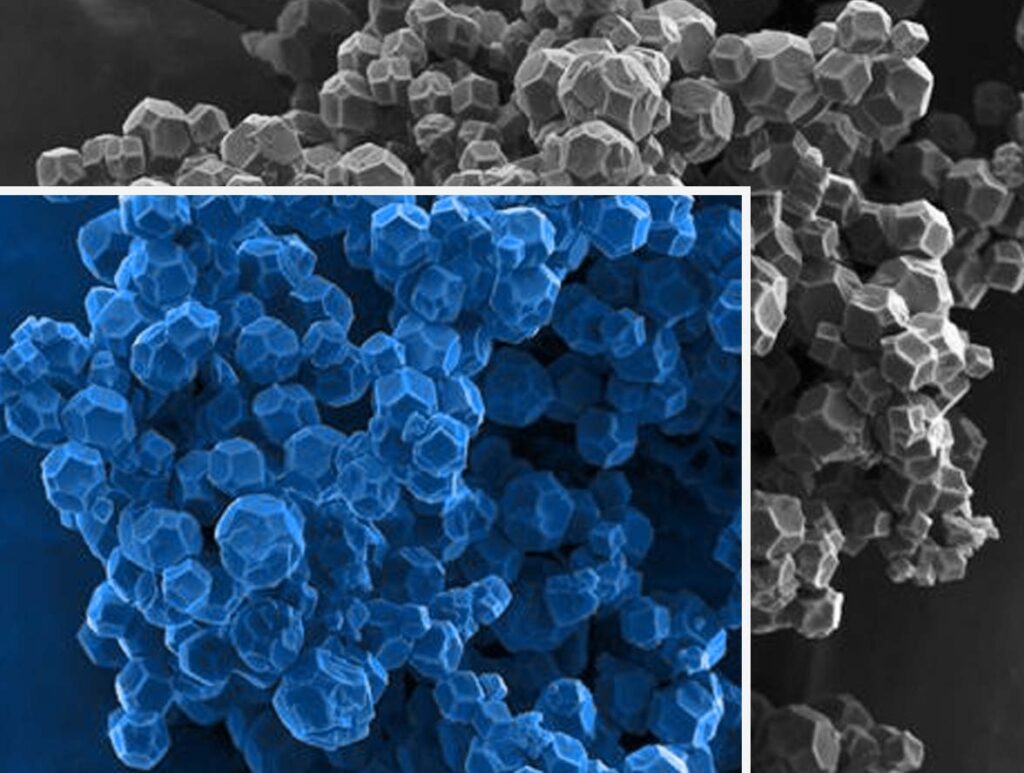
A native of Azerbaijan and a master’s graduate from the University of Toulon, Nizami Israfilov is enthusiastically embarking on his doctoral journey: “The goal of my research was to improve existing MOFs. By adding molecular fragments to a known ligand and combining this new molecule with other components, we were able to create a MOF with remarkable properties called SUM-103 (SUM: Strasbourg University Material).”
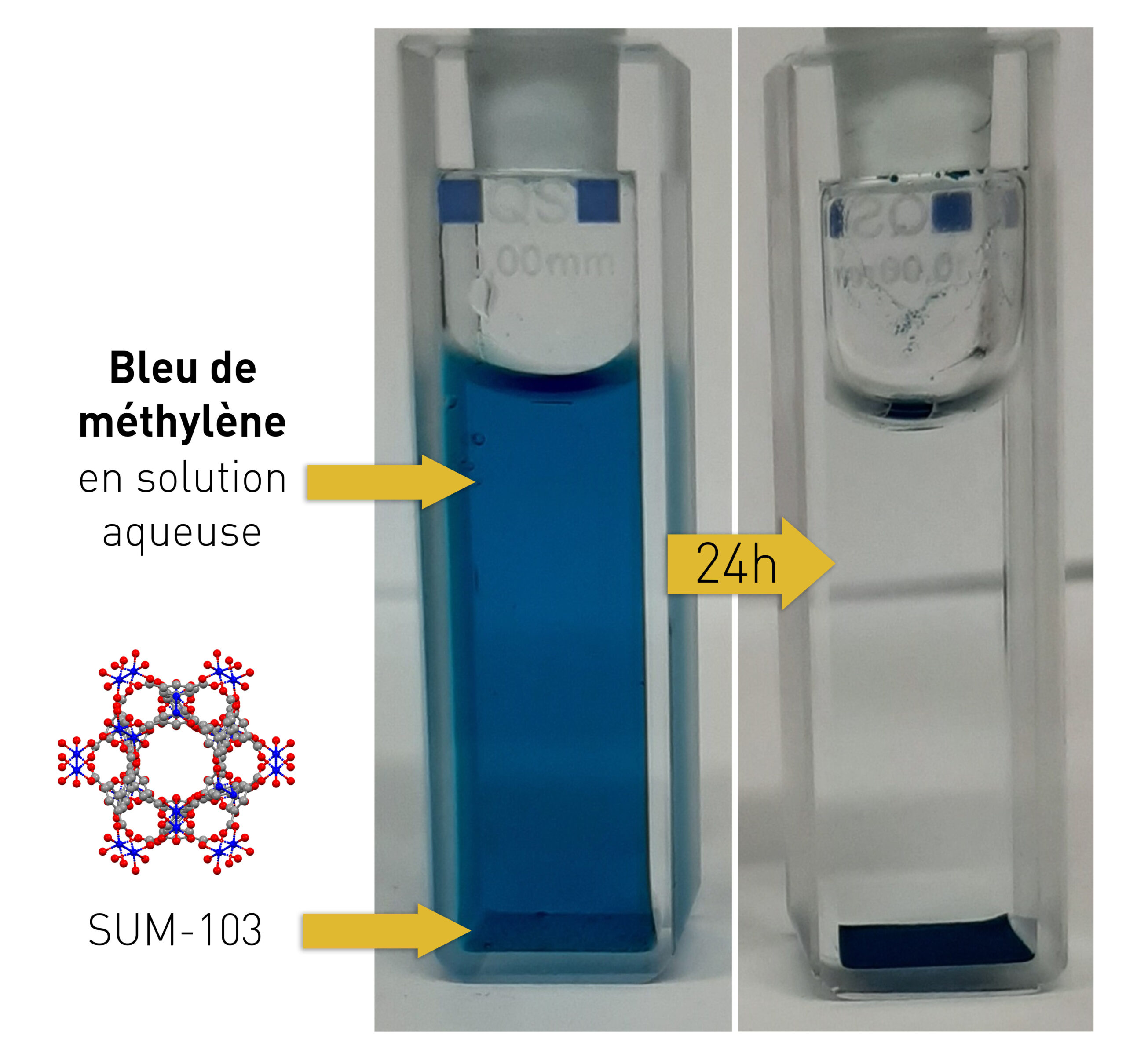
SUM-103 exceeds the researcher's expectations: it is highly stable in aqueous solutions and capturesCO₂ more efficiently than earlier comparable MOFs. Contaminant adsorption tests are also promising. SUM-103 has proven highly effective at removing dyes from water, particularly methylene blue, a dye widely used to color our clothing (Figure 1). This property is no small matter: today, 20% of global water pollution comes from the textile industry, primarily due to dyes1.
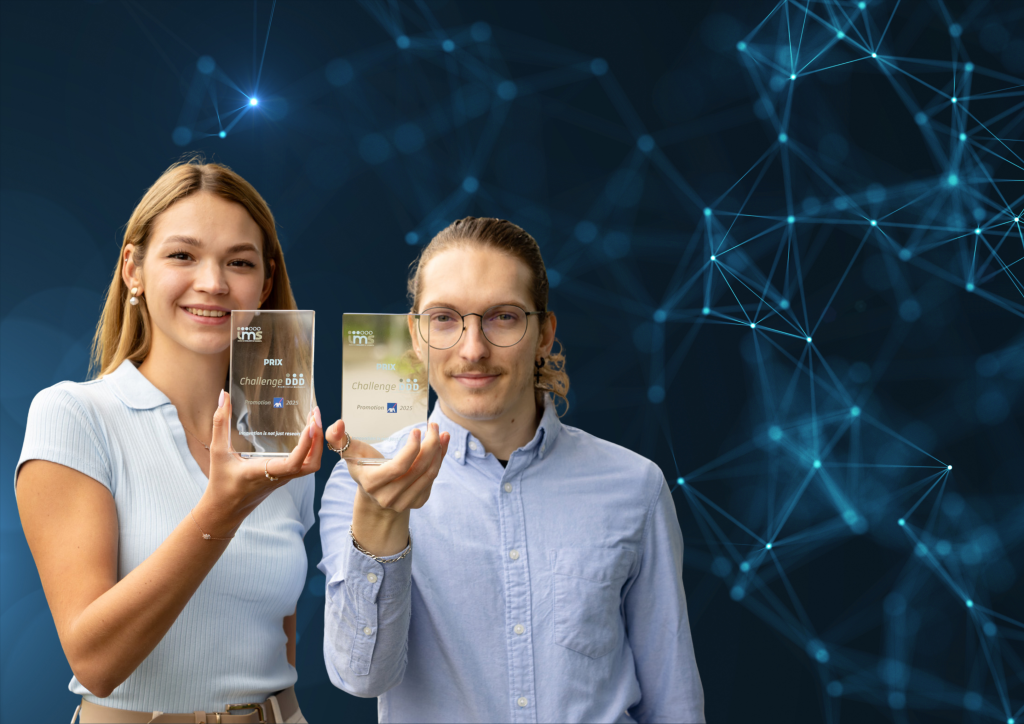
The potential of this material was quickly recognized, and his dissertation was honored with several awards. Nizami Israfilov was the 2021 winner of the “Mature your PhD” competition organized by SATT Conectus (the University of Strasbourg’s technology transfer office), and in 2022, he won the I-PhD competition organized by the Public Investment Bank (BPI)—two programs that support young PhDs developing disruptive technologies.
From the academic laboratory to the market
The goal now is to make this innovation available to industry. After he defended his dissertation in September 2022, Conectus offered Nizami Israfilov an 18-month postdoctoral fellowship to conduct additional testing. The young Ph.D. explains that“We now need to analyze the effectiveness of this new material under real-world conditions—for example, by testing itsCO₂ adsorption capacity in the presence of other gases and its ability to specifically target contaminants.” The researcher is also working to reducing the manufacturing cost of SUM-103 in order to explore large-scale industrial production of the material. “After this final testing phase, there are several options for leveraging our patent: creating a startup, securing a licensing agreement, and so on. I’m also open to any collaborations with companies to co-design customized solutions based on their needs.”
The development of this new material with a wide range of applications illustrates the tremendous potential for innovation in academic laboratories—a demonstration of how concrete applications can emerge from risky exploratory research that must be supported over the long term.
Our articles on the same topic